Color deviation. Dosing errors. Wasted batches. In coating and paint manufacturing, production inefficiencies do not just raise costs — they damage client relationships, delay shipments, and erode competitive margins. Yet for many manufacturers, these problems persist year after year, addressed with workarounds rather than resolved at the root.
This article identifies the six most significant challenges facing coating industry production today, examines what causes each one, and explains the engineering approaches that are changing how manufacturers operate — from small-batch specialty producers to large-scale industrial facilities supplying global markets.
Color inconsistency between production batches is the single most reported quality failure in paint and coating manufacturing. According to industry quality surveys, color-related rejections account for between 20% and 35% of all finished goods complaints in architectural and industrial coatings.
Color deviation rarely has a single cause. In most production environments, it results from a combination of compounding variables:
The financial impact of color inconsistency extends well beyond the rejected batch. A mid-sized paint manufacturer producing 800 batches per month, with a 15% color rejection rate and an average rework cost of $120 per batch, absorbs over $170,000 annually in avoidable quality losses — before accounting for client penalty clauses, logistics delays, or reputational damage.
For export-oriented manufacturers supplying branded paint companies or industrial OEMs, even a single high-profile color failure can suspend a supplier relationship that took years to build.
Modern laboratory-grade color matching systems eliminate the manual variables that drive batch variation. Instruments capable of achieving ΔE ≤ 0.5 for architectural paints and ΔE ≤ 1.0 for industrial inks close the gap between what human operators can achieve and what brand-consistent production demands.
Rather than relying on visual judgment, these systems use spectrophotometric measurement to lock formulation targets and verify output at every step. The result is reproducible color — not just within a single shift, but across factories, time zones, and raw material lots.
Explore laboratory tinting machine specifications →
Color matching systems can only perform as well as the dispensing equipment that delivers the formulation. In many coating operations, the weakest link in the production chain is not the formula — it is the accuracy with which ingredients are measured and dispensed.
The difference between a ±5g dispensing tolerance and a ±1g tolerance may sound insignificant. At production scale, it is not.
Consider a manufacturer producing 50 batches per day at an average batch weight of 30 kg. At ±5g tolerance, each batch absorbs up to 10g of combined dosing error across multiple components. Over 250 operating days per year, that amounts to over 125 kg of raw material that goes unaccounted in quality records — waste that is invisible in any single batch but continuous across a production year.
At ±1g accuracy, the same operation reduces this exposure by 80%, dramatically tightening the correlation between what was formulated and what was actually produced.
| Parameter | Manual dispensing | Automated fluid control |
|---|---|---|
| Dosing accuracy | ±3–10g | ±1g (at 30 kg batch) |
| Throughput per operator | 8–15 batches/hour | 30–60 batches/hour |
| Formulation error rate | 3–8% | <0.5% |
| Traceability | Paper log, operator-dependent | Digital, batch-linked records |
| Labor dependency | High | Low |
| Suitability for scale-up | Limited | Designed for scale |
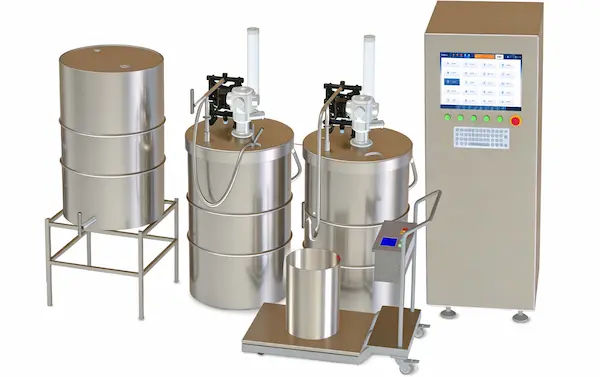
When evaluating fluid control systems for paint or ink production, the most commercially relevant specifications are: volumetric accuracy class, minimum dispensable quantity, self-priming capability, cleaning protocol, and integration with formulation software. Equipment that cannot communicate with a digital formulation database requires manual re-entry at every step — a process that introduces the very errors automation is intended to eliminate.
See automated ink and fluid dispensing systems →
Across Africa, Southeast Asia, and the Middle East — regions where coating production capacity has grown fastest over the past decade — manufacturers face a shared structural challenge: experienced production operators are scarce, expensive, and difficult to retain.
Paint and ink production is not unskilled work. An experienced tinting operator develops an intuitive understanding of how pigments behave across different base paints, humidity conditions, and raw material lots. That knowledge is not documented anywhere. When that operator leaves, it leaves with them.
Industry estimates suggest that replacing a skilled coating production operator costs between 1.5× and 2× their annual salary when recruitment, onboarding, and the quality failures that occur during the learning curve are fully accounted for.
Manual tinting and filling operations expose production to a predictable set of error types: incorrect pigment selection, sequence errors in multi-component addition, incomplete mixing, and contamination from inadequately cleaned equipment. Each error type has a low individual probability — but across hundreds of daily operations, they combine into a statistically significant quality risk.
The problem is not that operators are careless. It is that human performance under repetitive, high-volume, high-accuracy conditions is inherently variable in ways that no training program can fully eliminate.
The most effective response to labor dependency in coating production is not to hire more operators or pay higher wages — it is to re-engineer the process so that critical accuracy decisions are made by the system, not the person. Integrated production lines that embed color control, dispensing, and mixing into a single automated workflow reduce the skill level required at each workstation, make expert knowledge replicable, and allow production to scale without a proportional increase in headcount.
See integrated paint and coating production solutions →
Formulation errors differ from dosing errors in origin but are often indistinguishable in their consequences. A dosing error is a failure of execution — the formula was correct, but the quantities were wrong. A formulation error is a failure upstream: the wrong pigments, the wrong ratios, or the wrong sequence was specified in the first place.
When formulation data lives on paper or in disconnected spreadsheets, there is no mechanism to prevent an operator from using an outdated formula version, or to flag a deviation in real time before an entire batch is committed.
Digital formulation management systems address this by maintaining a single versioned source of truth for every formula. When a formulation is updated, older versions are immediately superseded in the production environment. When a batch is started, the software confirms ingredient identity, sequence, and target weight before any material is dispensed — and records every deviation from specification.
A production-ready formulation control system should:
Explore Sightec’s production software platform →
Paint, ink, and coating production frequently involves flammable solvents, reactive pigments, and fine particulate matter — conditions that create meaningful explosion and fire risk when not managed through appropriate equipment design and process controls.
The primary hazard categories in solvent-based coating production are:
Many manufacturers operating in markets with developing regulatory frameworks underestimate these risks until an incident occurs. The consequences — equipment destruction, production shutdown, liability, and human harm — are disproportionate to the preventive investment required.
For equipment operating in Zone 1 and Zone 2 hazardous areas (as classified under IECEx and ATEX frameworks), standard industrial equipment is not permissible. Explosion-proof designs isolate ignition sources through a combination of flameproof enclosures, intrinsically safe electrical circuits, and purged or pressurized housings.
For manufacturers exporting to European Union markets or operating under international safety standards, equipment certification is not optional. Buyers increasingly require documentation of equipment compliance before approving a supplier facility audit.
Beyond hardware design, modern production systems incorporate intelligent safety protocols — automatic shutdown triggers when solvent vapor concentrations approach threshold levels, torque monitoring that detects mechanical anomalies before they generate heat, and remote alarm systems that provide 24-hour incident notification without requiring on-site monitoring personnel.
The key principle is early intervention: stopping a risk before it escalates is orders of magnitude less costly than responding to an incident after it occurs.
Growth creates problems that small-batch production conceals. A manufacturer producing 50 batches per day with two experienced operators and a well-understood manual process may have acceptable quality performance. The same manufacturer at 500 batches per day, three shifts, and a distributed workforce faces a fundamentally different set of challenges.
Manual production processes depend on operator consistency. As batch volume increases, the workforce required to support it expands — and with that expansion comes greater variability in how procedures are executed. The informal knowledge that experienced operators carry does not transfer reliably through training. New operators make different errors. Quality deviates in ways that are difficult to trace to specific causes.
Statistical process control data from coating manufacturers who have scaled manual operations consistently shows the same pattern: defect rates that were acceptable at low volume become commercially damaging at high volume, because the absolute number of quality failures grows with scale even when the rate appears stable.
The manufacturers who scale successfully are those who systematize before they expand. An integrated hardware-software production system creates a controlled environment in which process parameters — dispensing accuracy, mixing time, color verification thresholds — are enforced by the system rather than dependent on individual operators. Adding capacity means adding equipment that runs the same validated process, not recruiting and training operators who will inevitably deviate from it.
Modular tinting and dispensing lines, combined with centralized digital formulation management, allow manufacturers to add production capacity in measurable increments while maintaining the quality consistency that their export customers require.
A paint manufacturer scaling from 200 to 2,000 batches per month does not simply hire ten times as many operators. The transition requires re-engineered workflows: automated dispensing replacing manual weighing, digital batch records replacing paper logs, real-time quality monitoring replacing end-of-line inspection. The result is a production environment in which quality is built into the process — not inspected in after the fact.
What is the most common quality problem in paint production?
Batch-to-batch color inconsistency is the most widely reported quality failure in paint and coating manufacturing. It results from a combination of manual dosing errors, raw material variation, and the absence of instrument-based color verification at critical process stages.
How do automated tinting machines reduce batch color variation?
Automated laboratory tinting machines use spectrophotometric measurement to verify color against a defined target standard at every batch. By replacing visual judgment with instrument-based comparison, they eliminate the operator subjectivity that drives most color variation. Systems calibrated to ΔE ≤ 0.5 can maintain color consistency across hundreds of batches without manual recalibration.
What accuracy should a paint dispensing system achieve?
For most architectural and industrial coating applications, a dispensing accuracy of ±1g at a 30 kg batch weight is the appropriate technical standard. Systems operating at ±5g or wider tolerance introduce cumulative formulation errors that are statistically significant at production scale — visible in finished product color, gloss, and chemical performance.
What certifications matter when buying coating production equipment for export markets?
For equipment used in flammable or explosive environments, ATEX (European Union) and IECEx (international) certifications are the primary standards to verify. ISO 9001 manufacturing certification and CE marking are baseline requirements for most European and regulated-market buyers. Manufacturers exporting to Africa or Southeast Asia should confirm that their equipment supplier can provide documentation in formats accepted by the relevant local regulatory authority.
How long does it take to see ROI from automating a manual tinting line?
Payback periods vary by production volume, existing defect rate, and labor cost structure. Manufacturers replacing fully manual tinting operations with automated dispensing and color verification typically report quality-related cost reductions of 25–40% within the first year, with full capital payback reached between 18 and 36 months depending on scale.
The six challenges covered in this article — color inconsistency, dosing inaccuracy, labor dependency, formulation errors, safety risk, and the quality pressures of scaling — are not isolated problems. They share a common root: production processes that rely on human judgment and manual execution for decisions that exceed reliable human consistency.
The coating manufacturers who are gaining ground in competitive export markets are addressing these challenges not with more supervision or tighter inspection, but with production systems in which precision is designed in, not managed in. The technology to achieve this is no longer limited to large multinationals — modular, scalable hardware-software solutions have made integrated production control accessible to mid-sized and growing manufacturers across emerging markets.
For manufacturers ready to move from reactive quality management to systematic production control, the path begins with an honest assessment of where in the process the variability originates — and what engineering approach is best suited to eliminate it.
Explore Sightec’s integrated solutions for paint and coating production →
Sightec is a high-tech manufacturer of color matching systems, high-precision fluid control equipment, and production management software for the coating, ink, and leather dyeing industries. With production and warehousing operations across Africa and global technical support, Sightec serves export markets across four continents.