In the coatings industry, the filling line is the final handshake with the customer. Regardless of how well the pigments were dispersed or how stable the resin system is, if the filling process results in drips, inaccurate weights, or contaminated seals, the brand’s hard-earned reputation suffers.
For paints and coatings—classified as non-Newtonian fluids—filling is far more complex than simply pouring a liquid into a can. Modern industrial requirements for efficiency, safety, and environmental compliance have transformed the filling machine from a simple pump and nozzle into a sophisticated mechatronic system that integrates fluid dynamics, precision weighing, explosion-proof safety protocols, and Industry 4.0 data management.
This article delves into the core engineering challenges and technological solutions that define today’s advanced paint filling equipment.
Part 1: Understanding the “Temperament” of the Product
The primary challenge in coating filling is the physical behavior of the material itself: high viscosity and thixotropy. This means the product is thick when static but becomes fluid when subjected to shear (like pumping or stirring).
1. Precision Filling and “Dribble” Control
For standard 5L to 20L pails, flow meters are often susceptible to inaccuracies caused by air entrapment or viscosity fluctuations. Consequently, high-end filling lines favor high-precision net weight filling.
A critical technical nuance here is in-flight compensation. When the filling valve closes, the column of paint still in the air—the “dribble”—will continue to fall into the pail. Advanced PLC systems utilize infrared sensors and load cells in tandem. The microcomputer automatically calculates the average in-flight weight and adjusts the cut-off point in real-time, ensuring that net weight errors are consistently held within ±0.1%. For expensive exterior paints or specialty coatings, this level of precision directly protects profit margins.
2. Anti-Drip and Bottom-Up Filling
High-viscosity paints are prone to “stringing”—leaving a trail of paint from the nozzle to the pail when the head retracts. This contaminates the pail chime and prevents a proper seal during the capping process.
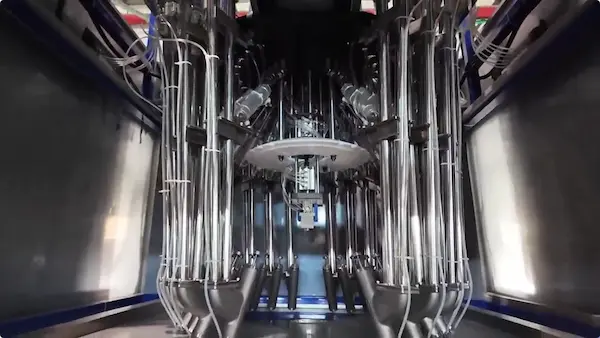
To combat this, professional systems utilize anti-drip nozzles with vacuum suck-back. Immediately after the shot, a pneumatic system creates a vacuum that pulls excess material back into the nozzle, ensuring a clean break. Furthermore, to prevent air entrapment (which causes pinholes in the final paint film), sub-surface (dip tube) filling is employed. The filling lance lowers itself to the bottom of the pail and rises with the liquid level, gently layering the paint from the bottom up and eliminating foam and turbulence.
Part 2: The Evolution of Machinery—From Manual to Intelligent
The choice of filling technology depends heavily on the manufacturing scale and product mix of the coating plant.
1. Semi-Automatic Explosion-Proof Fillers: Flexibility Meets Safety
For small-batch, multi-color production (such as tinting bases or specialty marine coatings), semi-automatic machines remain indispensable. These units are engineered with stringent safety standards, typically featuring ATEX or IECEx ratings (e.g., Ex d ib mb IIB T4) for all electrical components.
Operationally, they function on a “manual place, auto fill” basis. While they require an operator to handle the pails, the feeding system employs dual-speed filling logic: a fast-fill phase for efficiency, followed by a slow, trickle-fill phase as the target weight approaches to prevent splashing of solvent-based, flammable materials.
2. Fully Automatic Lines: The Nerve Center of Factory Logistics
In high-volume plants (e.g., producing over 200,000 liters daily), filling is integrated into a continuous flow.
Pail Handling: The process begins with automatic pail denesters and robotic depalletizers. Advanced collaborative robots (cobots), such as those seen in solutions from companies like Resino, must handle tapered pails while using force-feedback to navigate pail handles, preventing jams.
Closed-Loop Quality Control: High-speed lines integrate a checkweigher immediately after the filler. This scale provides real-time feedback to the filling heads. If the system detects a trend toward underweight fills, it automatically micro-adjusts the valve open time, creating a closed-loop control system that ensures 100% in-spec production without manual intervention.
Synchronized Data & Labeling: Modern lines are fully integrated with the ERP. Labels are printed on-demand, not from pre-printed stock. As a specific batch is filled, the printer receives ERP instructions to generate labels containing the exact production date, batch number, and formula code. Vision systems then verify the label’s placement and legibility before the pail proceeds to palletizing.
Part 3: The “Safety Barrier” Hidden Beneath the Steel
Paints contain volatile organic compounds (VOCs), creating a potentially explosive atmosphere (classified as Zone 1 or Zone 2). The true cost and complexity of a filling machine lie in its safety engineering.
Electrical Isolation: All motors, sensors, and control cabinets must be either flameproof (Ex d) or intrinsically safe (Ex i) . In many cases, agitators in the holding tank above the filler are powered by pneumatic motors rather than electric ones to eliminate any risk of spark ignition.
Static Grounding: The rapid flow of paint through pipes generates static electricity. A professional filling system must include positive-locking static grounding clamps. These clamps monitor the resistance between the pail, the filler, and earth ground. The machine will not begin filling until it verifies a perfect ground loop, preventing static discharge from igniting solvent vapors.
Voltage Block Technology: A unique challenge arises when filling paints destined for electrostatic spray applications. How do you supply paint continuously to a gun charged with 60,000+ volts without the voltage traveling back up the supply line? Specialized systems utilize voltage blocking technology—a shuttle system that physically isolates the paint supply from the grounded source during the charging phase, ensuring operator safety and stable electrostatic application.
Part 4: Industry Trends—Flexibility and Sustainability
Driven by customer demands for just-in-time delivery, paint manufacturers are moving away from massive single-batch runs toward “mass customization.”
1. Rapid Color Change Systems
Changing from a deep red industrial enamel to a white architectural coating used to require extensive manual flushing. Modern systems feature optimized manifold designs and Clean-in-Place (CIP) technology. Programmable flushing cycles use solvent and cleaning pigs to purge the previous color, with the waste collected and sent to solvent distillation units for recovery, minimizing environmental impact and material loss.
2. Continuous Processing
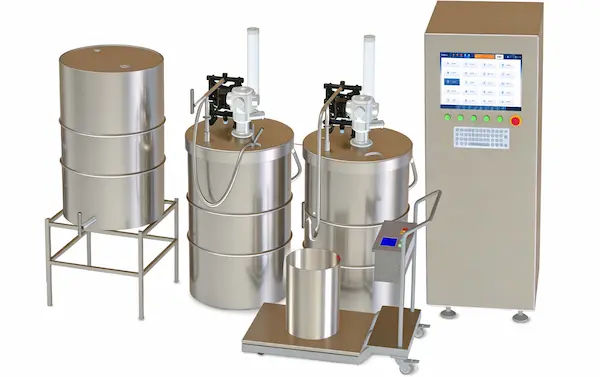
Traditional batch processing operates on a “make, stop, fill” cycle. This creates bottlenecks. Advanced plants now implement continuous processing. For example, as utilized in Oliver+Batlle’s design for Pinturas Montó, two large holding tanks work in alternation. While Tank A feeds the filling line, Tank B is preparing the next batch. This seamless handoff eliminates downtime and dramatically increases daily output, allowing filling to occur 24/7 without interruption.
Conclusion
The modern paint and coating filling machine is a sophisticated convergence of fluid physics, precision control, and stringent safety engineering. For plant managers and business owners, selecting a filling system is a strategic decision. It requires a choice between the ultimate flexibility of manual lines and the relentless efficiency of fully automated, continuous systems.
As environmental regulations tighten and labor costs rise, investing in advanced, explosion-proof filling technology is not just an operational upgrade—it is a critical step toward building a sustainable, competitive, and future-proof coatings business.