Imagine this. Your factory in Vietnam produces a brilliant “Sunset Red” coating. A customer in Germany orders the same color for a matching part. When the parts arrive, they look different under European sunlight. You face a rejection, a costly rework, and a hit to your reputation.
This is the daily reality of manufacturing in a globalized world. Colors must be consistent across borders, materials, and time. This is where global color certification systems like RAL, Pantone (PMS), and NCS come in. They provide the universal language of color.
But here’s the modern challenge: Simply having a Pantone swatch book is no longer enough. The real test is reproducing that color with perfect consistency, batch after batch, in factories thousands of miles apart. Manual mixing, with its inherent human error and variability, struggles to pass this test.
This is where computerized color matching moves from being a helpful tool to a critical business system. It’s not just about automation; it’s about achieving a level of precision, traceability, and repeatability that allows you to not just meet, but strategically exceed, the demands of global color standards.
Before exploring the solution, we must diagnose the systemic failures inherent in traditional, manual-centric color workflows. Even ISO-certified facilities often fall victim to the “Three Pillars of Variability”:
Physical color chips—whether Pantone, RAL, or custom master plaques—are organic materials. They are subject to UV degradation, oxidation, humidity, and physical wear. Research indicates that a physical swatch can shift by a measurable Delta-E ($\Delta E$) within just 6 to 12 months of frequent use. When your “source of truth” is drifting, your production will inevitably follow.
Human color perception is influenced by age, fatigue, medication, and even the observer’s mood. Furthermore, the inter-observer variability makes it impossible to achieve a consensus on “perfection” across different shifts or global locations. Without objective instrumentation, “matching the standard” remains an opinion rather than a fact.
In manual mixing environments, the “recipe” often exists in an operator’s notebook or an unlinked spreadsheet. If a batch fails a QC check, there is no granular data to determine if the error occurred during the weighing of pigments, a change in base resin viscosity, or a contaminated mixing vessel. This lack of traceability makes global certification an uphill battle.
A computerized system doesn’t replace RAL or Pantone; it digitizes and executes their standards with unparalleled fidelity. Think of it as giving a color standard a digital passport and a precision robot to enforce it.
Achieving Precision Color Matching with Spectrophotometers and Digital Libraries
The first step is moving from analog to digital. A spectrophotometer scans a physical standard—a Pantone chip, a customer sample, or a RAL swatch. It doesn’t just “see” the color; it captures its precise spectral data fingerprint.
This fingerprint becomes a digital color formula stored in the system’s library, linked forever to the standard’s ID (e.g., PMS 185 C). This digital standard never fades. It is the single source of truth for that color in your facility, perfectly aligned with the global color authority database.
H2: Ensuring Batch-to-Batch Consistency with Gravimetric Dispensing
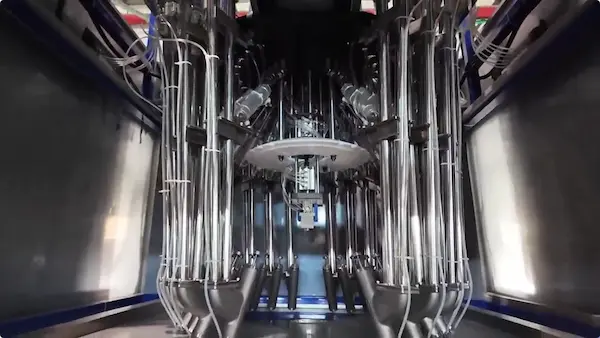
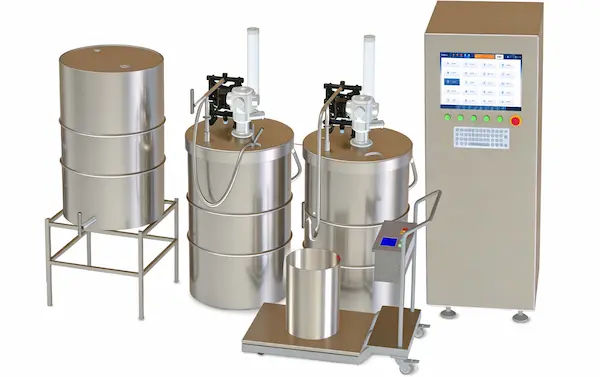
This is where precision becomes physical. The system’s software calculates the exact recipe. Then, a high-accuracy gravimetric dispenser takes over. It adds colorants and bases by weight, not volume, to a tolerance of ±0.1 grams.
Why weight? Because it’s unaffected by temperature or viscosity changes that affect volume. This gravimetric precision ensures the mathematical formula is executed perfectly every single time. It eliminates the #1 cause of batch failure: inaccurate ingredient measurement.
H2: Building a Defensible Quality Record with Automated Data Logging
Meeting a standard requires proof. A computerized system automatically creates a digital batch record for every single drum or batch produced.
This record is your defensible audit trail. It includes:
The exact standard used (e.g., “NCS S 2050-R”).
The color formula version.
The actual weight of every material dispensed.
Timestamps and operator ID.
Final colorimetry QC check results (Delta-E value).
If an auditor or customer asks, “How do you know this meets RAL 3020?” you have a complete, tamper-proof data log to prove it. This moves you from claiming compliance to demonstrating verifiable compliance.
When you master this process, you move beyond basic certification. You gain competitive edges.
1. You Enable “Global Color Sourcing.” Brands can source parts from your facilities in Asia and your partner’s in Europe with absolute confidence they will match. You become a reliable link in their global supply chain.
2. You Future-Proof Against Formulation Changes. Raw material suppliers sometimes change their pigments. With a digital color system, you can quickly re-formulate a certified color with new components while maintaining the exact same visual match, keeping production running.
3. You Unlock Customization at Scale. The system that flawlessly manages 50 RAL standards can just as easily manage 500 custom brand colors. It turns the complexity of mass customization into a manageable, profitable process.
Transitioning to this level of control is a project. Here’s a smart path:
1. Audit & Digitize: Start by auditing your most critical color standards. Use a high-quality spectrophotometer to build your initial digital color library.
2. Hardware Integration: Invest in a precision dispensing system (gravimetric is key) that can integrate seamlessly with your color matching software.
3. Process Re-engineering: Redesign your workflow from order intake to shipping around the digital thread. Train your team on the why, not just the how.
4 .Certification & Validation: Work with certifying bodies or your largest clients to validate your process. Use your data logs to prove your capability. Some may even approve your facility as a certified color producer.
Global color certification is no longer a passive, check-box activity. It is an active arena for demonstrating technical excellence and building unmatched customer trust.
A computerized color matching system transforms this challenge. It turns subjective color judgment into objective, data-driven science. It replaces anxiety over batch failures with confidence in perfect consistency. It elevates your operation from a commodity manufacturer to a strategic partner in color solutions.
In today’s market, meeting the standard is the price of entry. Exceeding it through precision and proof is how you win.
Moving beyond manual mixing is the most decisive step you can take to secure your position in demanding global supply chains. The journey requires the right technology and expertise.
Download our free, detailed whitepaper: “The Digital Color Factory: A Step-by-Step Guide to Achieving Unbreakable Color Consistency.” This guide dives deeper into system selection, process integration, and how to build a compelling business case for precision color management.
[Download Your Free “Digital Color Factory” Whitepaper Here]
Have specific questions about your color challenges? Our color science and automation specialists are ready to help. Schedule a free, 30-minute consultation to discuss your goals, from achieving specific Pantone or RAL certifications to streamlining your custom color workflow.