If you walk the floor of a high-volume personal care manufacturing facility, you know the sound of a healthy production line. It’s a rhythmic, uninterrupted hum. But for operations managers and production engineers handling “high-maintenance” SKUs, that hum is often interrupted by the sound of alarms and rejected bottles.
In the race to meet market demand, high-speed cosmetic filling often feels like the enemy of quality. This is particularly true for two growing categories: foam-rich cleansing products (shampoos, mousses) and sensitive, clean-beauty formulations (serums, preservative-free toners).
On a general-purpose line, you are forced to make a choice: dial down the speed to a crawl to prevent the “volcano effect” of overflowing foam, or run at speed and accept a higher scrap rate due to oxidation or separation.
This trade-off is no longer necessary. By understanding the fluid dynamics of your product and matching them with specific liquid filling machine technologies, you can maintain aggressive throughput while treating your formula with the gentleness of a laboratory pipette.
Here is your comprehensive engineering guide to mastering the stability of difficult cosmetic fluids in a mass-production environment.
The “soul” of a foaming cleanser or volumizing shampoo is its lattice structure. Consumers expect a dense, luxurious texture. However, the filling process is essentially a battle against turbulence and air entrapment.
In traditional gravity filling or basic overflow filling systems, liquid rushes from a header tank into the bottle. The velocity of the fluid hitting the bottom of the container creates kinetic energy. This turbulence entraps air, generating uncontrolled foam head.
If you are filling a 250ml bottle, you might end up with 150ml of liquid and 100ml of foam. As the foam settles, the bottle looks half-empty. To compensate, operators often overfill, leading to product waste and messy bottles that require post-fill washing.
To maintain speed without the mess, you must eliminate the “drop.” The industry standard for foaming products is bottom-up filling combined with servo-driven nozzle control.
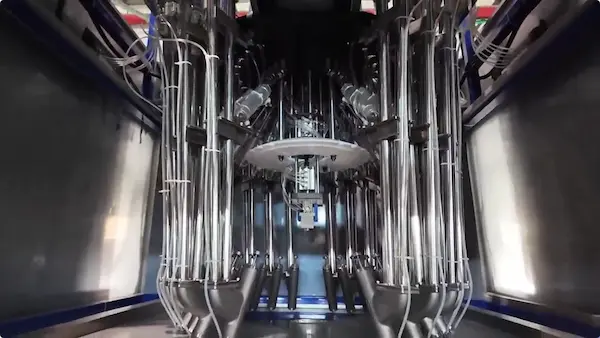
How it works: The filling nozzle physically dives inside the bottle, descending to just above the bottom. As the piston pump or flow meter dispenses the product, the nozzle retracts upwards, synchronized perfectly with the rising liquid level.
The “Submerged” Technique: For extremely foamy products, the nozzle tip can stay slightly submerged under the liquid surface as it rises. This eliminates the air-liquid interface almost entirely, preventing the splashing that causes foam nucleation.
The Result: You can run foamy shampoos at high velocities because the fluid dynamics remain laminar (smooth) rather than turbulent.
For products like pressurized shaving gels or aerosol cleansing mousses, the challenge isn’t just splashing; it is back-pressure.
The Mechanism: Advanced aerosol filling lines utilize a vacuum-and-fill technique. Before the product is injected, the machine draws a vacuum on the canister to evacuate ambient air.
Why it matters: This creates a pressure differential that sucks the product in swiftly without creating air pockets. It ensures that the first pump the consumer uses delivers a perfect mousse, not a sputter of gas.
Not all foams are watery; some start as thick gels. Here, the consistency of the flow is paramount. Servo-driven piston pumps provide a linear velocity profile. Unlike pneumatic systems that can “pulse” or jerk at the start/stop of a cycle, a servo motor creates a smooth acceleration and deceleration curve.
The cosmetic market has shifted toward “active-rich” and “preservative-free” formulas. Ingredients like Vitamin C (Ascorbic Acid), Retinol, and probiotic lysates are chemically fragile. They degrade when exposed to oxygen, metal ions, or mechanical stress.
If your cosmetic filling equipment isn’t designed for these sensitivities, you are essentially damaging the product before it even leaves the factory.
Oxidation turns clear serums brown and renders antioxidants useless.
The Closed-Loop Solution: To manufacture medical-grade or clean-beauty skincare, you need a nitrogen-inerting system.
Tank Blanketing: Food-grade nitrogen is pumped into the headspace of the product hopper, pushing out oxygen.
Pre-Fill Purge: Before the liquid enters the bottle, a nozzle injects a puff of nitrogen into the empty container, displacing the oxygen-rich air.
Post-Fill Purge: Immediately after filling and before capping, a final nitrogen puff ensures the headspace in the sealed bottle is inert.
The ROI: This extends the shelf-life of unstable natural formulas and ensures the consumer receives a potent product, protecting your brand from “it didn’t work” reviews.
Many active ingredients are acidic. Contact with standard stainless steel or brass fittings can cause ion leaching, acting as a catalyst for degradation.
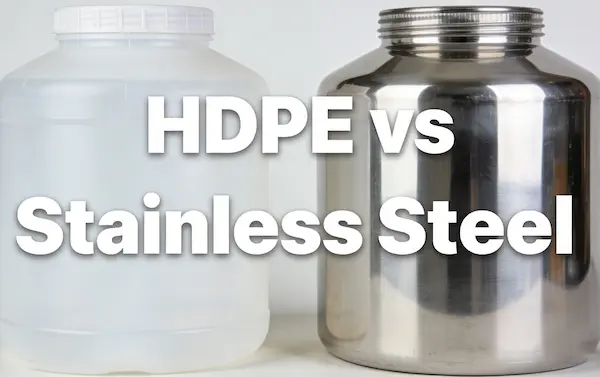
Material Selection: Top-tier cosmetic packaging machinery utilizes 316L Low-Carbon Stainless Steel for all product contact parts.
Surface Finish: It’s not just about the metal; it’s about the finish. Electropolishing (EP) creates a mirror-like surface (Ra < 0.4µm) that prevents product adhesion and biofilm buildup.
Specialty Polymers: For extremely reactive acids, parts may need to be machined from pharmaceutical-grade PTFE (Teflon) or PEEK to ensure zero chemical reactivity.
This is a hidden killer of quality. High-speed centrifugal pumps use fast-spinning impellers. This creates high shear force.
The Problem: Shear force can tear apart long-chain polymers (thickeners), causing your lotion to become runny. It can also rupture micro-encapsulated beads (like vitamin beads in a clear gel), ruining the visual appeal.
The Solution – Peristaltic and Lobe Pumps:
Peristaltic Filling: The product is contained within a medical-grade silicone tube. Rotors squeeze the tube to move the fluid. The machine never touches the product, and the shear force is negligible. This is the gold standard for serums and eye drops.
Lobe Pumps: For thicker creams, rotary lobe pumps move large cavities of product gently, maintaining the viscosity and structure of the emulsion.
In the era of Industry 4.0, relying on an operator’s “gut feeling” to adjust nozzle height or pump speed is a liability. Modern stability is achieved through data-driven Human Machine Interfaces (HMI).
A change in temperature can change a lotion’s viscosity, which changes the fill volume.
Mass Flow Meters (Coriolis): Instead of measuring volume, advanced fillers measure mass.
For the highest precision, integrate checkweighers directly into the filling turret.
1.The bottle is filled.
2.It is immediately weighed.
3.If the weight drifts (e.g., 0.5g too light), the PLC automatically adjusts the pump stroke for the next bottle in milliseconds. This closed-loop system reduces product giveaway (overfilling) to near zero, which is a massive cost saving when filling expensive serums priced at $2,000 per liter.
Stability also means biological stability. Bacterial contamination is a disaster. Modern lines feature automatic CIP systems.
Quick Changeover: The best machines allow for “tool-less” removal of contact parts.
Investing in a specialized cosmetic filling line designed for sensitive and foaming products is often viewed as a steep capital expenditure (CapEx).
1.Reduced Waste: Standard machines often require 2-5% overfill to ensure legal compliance due to foam variance. Reducing this to 0.5% using servo-control saves thousands of liters of bulk product annually.
2.Brand Protection: One recalled batch due to bacterial growth or oxidized ingredients can cost millions in logistics and reputation damage. Sanitary, nitrogen-purged filling is an insurance policy.
3.Production Agility: A machine that handles water-thin toners and thick hair masks (using switchable pump modules) allows you to say “Yes” to more contract manufacturing orders or R&D innovations.
In the cosmetic industry, the packaging is the product. A bottle of shampoo that is under-filled due to foam issues, or a serum that has turned yellow due to oxidation, tells the consumer that the brand does not care.
High-speed production does not have to mean low-quality control. By leveraging bottom-up filling, nitrogen inerting, and low-shear pumping technologies, you transform your filling line from a bottleneck into a competitive advantage. You achieve the “Golden Ratio” of manufacturing: maximum throughput with pharmaceutical-grade stability.
Every formula has a unique rheology. A generic catalog machine is rarely the answer for high-end cosmetics.
We specialize in engineering customized filling, capping, and labeling solutions tailored to the specific viscosity and chemical needs of the personal care industry.
Whether you are scaling up a boutique organic skincare brand or retrofitting a multinational high-speed line, we can help you analyze your fluid dynamics to select the perfect pump and nozzle configuration.
What to do next:
Step 1: [Click Here to Download] our technical whitepaper: “The Fluid Dynamics of Filling: A Guide for Cosmetic Engineers.” It includes a viscosity chart and pump selection matrix.
Step 2: Request a Free Rheology Test. Send us a sample of your most difficult-to-fill product. We will test it in our lab and send you a video demonstrating exactly how we handle the foam and flow, along with a guaranteed speed estimate.
[Contact Our Engineering Team Today] to stop fighting your foam and start managing your production.