How to Choose an Automatic Paint Dispenser for Small-Batch Paint Production
Ben Cai | Published on November 27, 2025
Small-batch paint production—whether for custom decorative paints, automotive refinish coatings, or specialty industrial formulations—presents unique challenges that differ sharply from mass manufacturing. Unlike large-scale plants, small-batch operations grapple with frequent color changes, tight precision requirements for trace ingredients, limited production space, and the need to minimize waste (since even small discrepancies can render an entire batch unusable).
An automatic paint dispenser is not just a “nice-to-have” for these operations; it’s a critical tool that bridges the gap between efficiency, consistency, and cost control. However, choosing the right model requires more than just comparing prices or specs—it demands aligning the dispenser’s capabilities with the specific pain points of small-batch production.
In this guide, we’ll break down the professional selection framework for automatic paint dispensers, grounded in the realities of small-batch workflows. We’ll also reference a lab-grade dosing solution that has proven effective for global small-batch paint factories, using its features to illustrate how a well-matched dispenser solves core challenges—without treating it as a sales pitch.
Before diving into selection criteria, it’s critical to understand the unique hurdles of small-batch paint production. These challenges directly dictate what you need from an automatic paint dispenser:
Small-batch operations often handle 100mL test samples, 5L custom orders, and 10kg specialty batches—all in a single day. Each color change requires flushing lines, adjusting formulas, and ensuring no cross-contamination. A poorly designed dispenser will slow this process, leading to downtime that eats into profits.
For small-batch producers, repeat customers (e.g., local contractors, automotive shops) demand consistent color match across orders. Even a ΔE value above 0.5 can result in returns, as there’s no large production run to absorb minor discrepancies. This means precision in 微量 dosing (down to 0.1g or less) is non-negotiable.
Most small-batch factories operate in compact workshops (≤100㎡) and have lean teams. The ideal dispenser must be space-efficient, easy to operate without specialized training, and require minimal maintenance.
Small-batch production has higher per-unit costs, so raw material waste (common with manual tinting) and labor hours spent on color matching directly impact profitability. A dispenser that cuts waste by 30% or more can deliver a rapid return on investment (ROI).
Many small-batch producers export to regional markets (e.g., Europe, Southeast Asia, North America), requiring equipment to meet local safety standards (e.g., ATEX for solvent-based paints) and voltage requirements (110V/230V).
These challenges make “one-size-fits-all” dispensers ineffective. The right model must be engineered to address small-batch-specific needs—precision, flexibility, and efficiency—without sacrificing compliance or scalability.
When evaluating automatic paint dispensers, focus on these six non-negotiable standards. Each criterion is tailored to small-batch workflows, with real-world examples to illustrate why they matter.
For small-batch paint production, precision is not just about “being accurate”—it’s about consistent micro-dosing (for color pastes and additives) and eliminating batch-to-batch variation. Here’s how to assess it:
Key Metrics to Evaluate:
Minimum dispensing volume: Look for models that handle ≤0.1g of trace ingredients (e.g., colorants, UV stabilizers)—critical for small batches where even tiny deviations alter the final color.
Repeatability: The dispenser should maintain accuracy across multiple runs (e.g., ±0.05g for batches up to 10kg).
Scale precision: For lab-scale samples (100mL-1L), a high-resolution scale (e.g., ±0.005g for 750g measuring range) ensures formula replication when scaling up to 10kg batches.
Real-World Application:
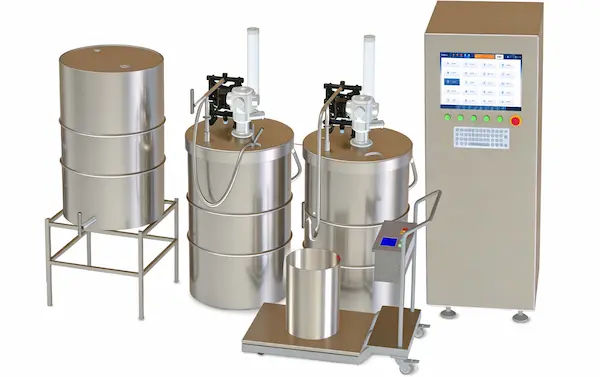
A lab dosing machine (Lab Dosing Machine) designed for small-batch production offers a weighing accuracy of up to 0.05g, with a 750g measuring range that delivers ±0.005g precision 、. This level of accuracy is game-changing for small-batch operations: when formulating a 500mL custom paint batch, adding 0.3g of a red colorant instead of 0.25g can create a noticeable shade difference. By maintaining micro-dosing consistency, this dispenser eliminates the “guesswork” of manual tinting and ensures that lab samples match production batches—a common pain point for small factories.
Why It Matters for Small-Batch Production:
Batch variation is 3x more costly for small operations (since there’s no large run to offset waste). A dispenser with precision at the micro-level cuts return rates by up to 80% and builds trust with repeat customers.
Small-batch production thrives on versatility—your dispenser must handle everything from 100mL test samples to 10kg orders, across multiple paint types. Evaluate flexibility through these lenses:
Key Metrics to Evaluate:
Channel count: Look for modular designs that support 16-60 raw material channels. More channels mean you can store common colorants and additives on-site, reducing changeover time for new colors.
Container compatibility: The dispenser should work with small-batch containers (e.g., 1L bottles, 5L buckets) with minimal adjustments. A minimum container opening of 70mm, for example, accommodates most standard small-batch vessels without requiring custom adapters .
Viscosity range: Ensure the dispenser handles your typical paint viscosity (e.g., <3500CPS) to avoid clogs or inconsistent flow—critical for water-based decorative paints and solvent-based automotive refinish coatings .
Real-World Application:
The Lab Dosing Machine excels here with a modular channel design (up to 60 channels) and compatibility with containers as small as 100mL (minimum opening 70mm) . For a small European paint factory specializing in custom wood finishes, this means switching between 5L oak stain batches and 1L metallic accent batches in minutes—no need to reconfigure the entire system. Its ability to handle viscosities up to 3500CPS also covers their entire product line, from thin water-based primers to thicker polyurethane topcoats .
Why It Matters for Small-Batch Production:
Flexibility directly impacts throughput. A dispenser that requires 30 minutes to reconfigure for a new batch will limit you to 10-12 orders per day, while a flexible model can handle 20+—a 67% increase in productivity.
A dispenser should fit into your current operations, not force you to overhaul processes. Focus on compatibility with:
Key Metrics to Evaluate:
Material types: Ensure the dispenser works with your paint base (water-based/solvent-based) and ingredients (pigments, additives, solvents). Look for corrosion-resistant components (e.g., stainless steel valves) for solvent-based formulas .
Software integration: Compatibility with ERP systems and color measurement software (e.g., spectrophotometer tools) enables digital formula management—critical for tracking small-batch orders and replicating past projects .
Raw material storage: The ability to share raw material tanks with production lines (e.g., 20L drums, IBCs) eliminates redundant inventory and ensures consistency between lab samples and full batches .
Real-World Application:
Many small-batch factories use standalone lab equipment that doesn’t sync with production lines, leading to “sample vs. production” color discrepancies. The Lab Dosing Machine solves this by sharing raw material tanks with production dispensers and integrating with mainstream color measurement software and ERP systems . A Thai automotive refinish shop, for example, now uses the dispenser to test 100mL paint samples for customer approval, then replicates the exact formula on their production line—no more rework due to ingredient differences.
Why It Matters for Small-Batch Production:
Incompatible equipment leads to double work (e.g., re-entering formulas into production systems) and human error. Integration cuts administrative time by 40% and ensures that every batch—whether 100mL or 10kg—matches the approved sample.
Small-batch teams are often lean (1-3 operators), so the dispenser should automate repetitive tasks to minimize labor costs and errors. Evaluate these intelligent features:
Key Metrics to Evaluate:
Formula storage: The ability to store 1,000+ formulas (digital recall) eliminates manual calculations and ensures consistency across repeat orders.
Automatic cleaning: Built-in automatic valve cleaning reduces cross-contamination between batches and saves time (no manual flushing) .
Batch tracking: Digital records of each run (ingredients used, batch number, date) simplify compliance audits and order tracing—critical for exporting to markets like the EU or North America.
Real-World Application:
A small U.S.-based specialty paint factory previously relied on manual formula logging, which led to errors when repeating orders. After switching to the Lab Dosing Machine, they now store 500+ custom formulas in the system, with automatic batch tracking. When a customer reorders a 3kg industrial coating, the operator simply scans the order barcode, and the dispenser pulls up the exact formula—including 0.08g of a specialty UV additive. The automatic valve cleaning also cuts changeover time from 15 minutes to 2 minutes, allowing them to handle more orders per day with the same team .
Why It Matters for Small-Batch Production:
Labor costs account for 30-40% of small-batch production expenses. Intelligent features reduce operator time per batch by 50% and eliminate costly errors (e.g., mismeasuring additives).
If you export or operate in global markets, your dispenser must comply with local regulations—non-negotiable for avoiding customs delays or safety fines. Focus on:
Key Metrics to Evaluate:
Explosion-proof options: For solvent-based paints, look for ATEX-certified or UL-listed models (e.g., pressurized control cabinets) to meet European or North American safety standards .
Voltage adaptability: Dual-voltage support (110V/230V) ensures compatibility with power grids in Southeast Asia, Europe, and North America.
Material safety: Corrosion-resistant components and sealed electrical systems prevent leaks or sparks when handling flammable solvents.
Real-World Application:
A German small-batch paint factory specializing in solvent-based industrial coatings needed a dispenser that met ATEX IIB T4 standards. The Lab Dosing Machine’s optional pressurized control cabinet and anti-static design allowed them to pass local safety audits, enabling them to export to France and Spain without compliance issues . Its dual-voltage support also made it easy to expand to a satellite workshop in Malaysia (230V) without purchasing a new machine.
Why It Matters for Small-Batch Production:
Non-compliant equipment can lead to $10,000+ fines or banned shipments. Investing in a compliant dispenser opens up global markets and reduces regulatory risk.
Small-batch factories often fixate on upfront costs, but the true value of a dispenser lies in its long-term TCO—including maintenance, spare parts, energy use, and waste reduction. Evaluate:
Key Metrics to Evaluate:
Maintenance frequency: Look for durable components (e.g., two-stage multi-flow valves) that require servicing only every 6-12 months .
Spare parts availability: Common parts (filters, seals, valves) should be readily available globally or shipped within 7 days to avoid downtime.
Energy efficiency: Low-power consumption (≤150W) reduces monthly electricity bills—critical for 8-hour daily operation.
Waste reduction: A dispenser that cuts raw material waste by 30-50% (vs. manual tinting) delivers rapid ROI, even with a higher upfront cost.
Real-World Application:
A Brazilian small-batch paint factory compared two dispensers: a budget model ($30k) and the Lab Dosing Machine ($45k). The budget model required monthly filter replacements ($500/month) and wasted 15% of raw materials, while the Lab Dosing Machine’s durable valves needed servicing only once a year ($200/year) and cut waste to 5% . After 18 months, the TCO of the budget model was $39k (purchase + maintenance + waste), while the Lab Dosing Machine’s TCO was $46.2k—but by month 24, the Lab Dosing Machine became cheaper, saving $5k/year thereafter.
Why It Matters for Small-Batch Production:
Small-batch operations have thin profit margins—TCO directly impacts profitability. A slightly more expensive dispenser with lower maintenance and waste costs will outperform a budget model in the long run.
Not all automatic paint dispensers are designed for small-batch workflows. Below is a professional comparison of three common types, highlighting why lab-grade dosing machines (like the Lab Dosing Machine) are the ideal fit:
Lab-grade dosing machines strike the perfect balance of precision, flexibility, and efficiency for small-batch production. Unlike standard dispensers, they’re engineered to handle micro-volumes and frequent color changes—without sacrificing the compliance or integration needed for global operations 、.
To illustrate how the right dispenser transforms small-batch production, let’s look at a real-world example (disguised to protect privacy):
A small Dutch paint factory specializing in custom decorative and automotive refinish paints (monthly output: 3,000L; batch sizes: 100mL-10kg). Prior to upgrading, they used manual tinting and a basic semi-automatic dispenser:
Batch color variation (ΔE >1.0) led to 12% of orders being returned.
Changeover between colors took 20 minutes, limiting daily output to 8-10 batches.
Raw material waste was 18% (due to manual measurement errors).
Compliance issues prevented them from exporting to France (no ATEX certification).
The factory used the 6 criteria above to evaluate options, ultimately choosing the Lab Dosing Machine for:
0.05g precision to eliminate batch variation .
60-channel modular design to handle their 45+ colorants and additives .
ATEX-compliant pressurized control cabinet for solvent-based refinish paints .
Integration with their existing ERP system for batch tracking .
Automatic valve cleaning to reduce changeover time .
Color consistency: ΔE reduced to ≤0.5, cutting return rates to 1%.
Efficiency: Changeover time dropped to 2 minutes, increasing daily output to 20+ batches.
Waste reduction: Raw material waste fell to 4%, saving €2,500/month.
Market expansion: ATEX certification enabled exports to France and Belgium, boosting revenue by 35%.
Labor savings: One operator now handles what previously required two staff, cutting labor costs by 50%.
This case demonstrates that the right dispenser isn’t just a piece of equipment—it’s a driver of growth for small-batch paint factories.
Even with a clear framework, small-batch producers often make these costly errors. Here’s how to avoid them:
Choosing the cheapest dispenser may save money initially, but higher maintenance and waste costs will erode profits. Always calculate TCO (purchase price + maintenance + waste + energy) over 2-3 years.
For small batches, 1g of error in a 5kg batch is a 0.02% deviation—enough to alter color. Don’t settle for dispensers with precision worse than ±0.1g.
If your primary batches are 1L-5L, a dispenser designed for 20L+ buckets will require custom adapters and slow down production. Verify minimum container opening and batch size ranges .
If you plan to expand globally, invest in a dispenser with regional certifications (ATEX, UL, TISI) upfront—retrofitting is often more expensive than buying compliant equipment .
Manual formula logging and batch tracking are time-consuming and error-prone. Ensure the dispenser works with your ERP or color management software .
Choosing an automatic paint dispenser for small-batch production boils down to one core principle: prioritize precision, flexibility, and compatibility over size or upfront cost. Small-batch operations don’t need a “one-size-fits-all” production dispenser—they need a specialized tool that handles micro-volumes, frequent color changes, and lean workflows.
Lab-grade dosing machines (like the Lab Dosing Machine) excel in this context, offering:
Micro-dosing precision (≤0.05g) to eliminate batch variation .
Flexibility to handle 100mL-10kg batches and 60+ raw materials .
Compliance with global safety standards for export .
Integration with existing software to streamline workflows .
Low TCO through durable components and waste reduction .
Ultimately, the best dispenser is one that fits your unique production needs—whether you’re a startup handling 100mL test samples or a growing factory exporting custom coatings. By using the 6 professional criteria outlined here, you’ll avoid costly mistakes and select a dispenser that drives efficiency, consistency, and growth.
Every small-batch paint factory has unique needs—from material types to target markets. Instead of guessing which dispenser fits, get a customized recommendation tailored to your workflow.
Take Action Now: Share your production details (monthly output, batch sizes, material types, target markets) via email or WhatsApp, and our technical team will provide a free, no-obligation selection guide. We’ll help you match your needs to the right dispenser features, calculate potential ROI, and avoid common pitfalls.
Don’t let outdated or mismatched equipment hold back your small-batch production. Invest in a dispenser that works as hard as your team—delivering consistency, efficiency, and profitability.
Contact Us:
E-mail: info@sightec.netWhatsApp: +86 181 3719 7160Web: www.sightec.net