Part 1: The Core Challenge – Why Traditional Ink Dispensing Is No Longer Enough
To understand the revolution brought by the DM-48, we must first clearly understand the problems it solves.
1. The Problem of Precision and Color Deviation:
Human operators, no matter how skilled, cannot consistently measure materials to a fraction of a gram. A small error in weighing a potent pigment can alter the final color significantly. This leads to “color deviation,” requiring the entire batch to be corrected or, in the worst case, discarded. This “re-work” process wastes time, raw materials, and labor.
2. The Problem of Inefficiency and Slow Batch Times:
Manual dispensing is a slow, sequential process. An operator must handle one ingredient at a time. For a complex color recipe involving dozens of components, the weighing and mixing process can take hours. This creates a bottleneck in the production line, limiting overall output and making it difficult to respond quickly to urgent orders.
3. The Problem of Material Waste and Cost:
Every drop of ink wasted during dispensing, every batch that must be thrown away, directly impacts the company’s bottom line. High-value pigments and resins are expensive. Inaccurate dispensing leads to significant, ongoing material loss that erodes profit margins over time.
4. The Problem of VOC Emissions and Workplace Safety:
Many inks, especially solvent-based varieties, contain Volatile Organic Compounds (VOCs). Manual handling and cleaning of dispensing equipment can increase the exposure of these chemicals to the workplace environment. This poses health risks to operators and requires expensive ventilation and air filtration systems to manage. Regulators and customers are increasingly demanding lower VOC emissions.
5. The Problem of Data and Traceability:
In a manual system, record-keeping is often done on paper. This makes it difficult to trace a quality issue back to its source. Was it a weighing error? A wrong ingredient? Without digital data for every batch, manufacturers lack the insight needed to improve their processes and ensure perfect repeatability continuously.
The SIGHTEC DM-48 is engineered from the ground up to provide a definitive answer to every one of these challenges.
Part 2: A Deep Dive into the DM-48 – Engineering Excellence for Industrial Performance
The DM-48 is not a minor upgrade to existing equipment. It is a purpose-built solution that combines robust mechanical engineering with advanced control systems.
2.1 The Heart of the System: The Swing-Arm and Multi-Valve Design
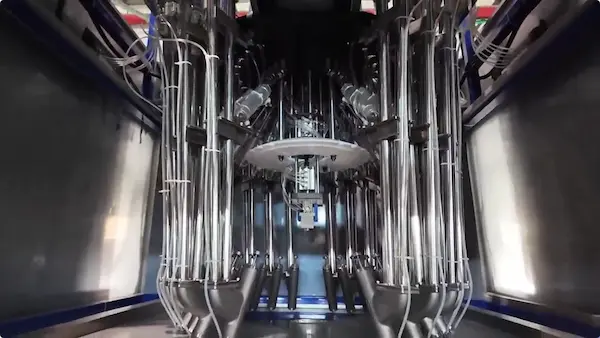
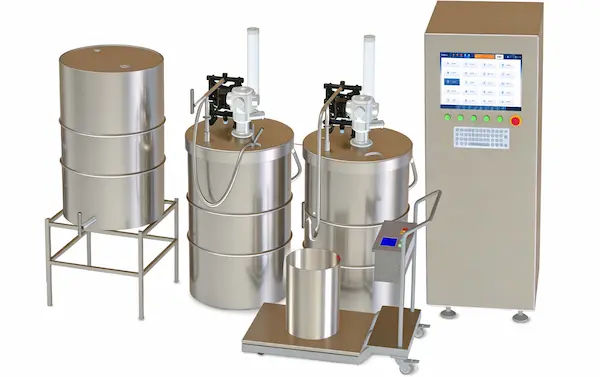
The “Swing-Arm” design is a key feature. This allows the dispensing head to move smoothly and precisely over a large work area. This flexibility is crucial because it can service different types and sizes of containers—from small pails to large 1000-liter IBCs (Intermediate Bulk Containers)—without requiring complex reconfiguration.
The system supports an impressive up to 48 individual valves. Each valve is responsible for dispensing a specific base ink, pigment, or additive. This multi-valve architecture is the foundation of its efficiency. Instead of a single operator slowly working through a list of ingredients, the DM-48 can manage dozens of components in a coordinated, parallel process. It dramatically compresses the total dispensing time.
2.2 The Brain of the Operation: Precision Control and ERP Integration
Precision is not just about the hardware; it is about the intelligence that controls it. The DM-48’s control system is the brain that orchestrates the entire operation.
Formula Management: Operators can store thousands of color formulas in the system. To start a batch, they simply select the recipe and the desired batch size. The system automatically calculates the exact amount of each component needed.
Seamless ERP Connection: This is a critical feature for modern smart factories. The DM-48 can connect directly with the company’s Enterprise Resource Planning (ERP) system. When a production order is released in the ERP, the details are sent automatically to the dispenser. This eliminates manual data entry errors, ensures the correct formula is used every time, and provides real-time data on material consumption for inventory management. This creates a closed-loop, digital production environment.
2.3 The Hands of the Artist: The Three-Stage Multi-Flow Valve
This is where the DM-48’s precision becomes truly remarkable. The valve is not a simple on/off switch. It is a sophisticated Three-Stage Multi-Flow Valve made from high-quality 304 stainless steel for durability and chemical resistance.
How does it work? Imagine a skilled artist adding the final, critical drops of paint to a masterpiece. They do not pour; they apply with control and finesse. The DM-48’s valve operates in a similar way:
High-Flow Stage: The valve opens fully to dispense the bulk of the material quickly. This maximizes speed and efficiency for the majority of the components.
Medium-Flow Stage: As the system approaches the target weight, the valve reduces the flow rate. This allows for a more controlled and precise approach, preventing overshoot.
Dripping Stage (As low as 0.1g): For the final few grams, the valve enters a slow, drop-by-drop mode. This is the “fine-tuning” phase, ensuring the measurement is perfect down to a minuscule 0.1 grams. This level of control is impossible to achieve with manual methods or simpler dispensers.
This intelligent process ensures both high speed and extreme accuracy, a combination that was previously very difficult to find in a single machine.
Part 3: Quantifying the Impact – The Tangible Benefits for Your Business
Understanding the technology is one thing; understanding how it improves your business is another. The benefits of the DM-48 are direct, measurable, and transformative.
3.1 Unmatched Color Consistency and Quality
By eliminating human error in measurement, the DM-48 guarantees that every batch of ink, regardless of when it is made or who operates the machine, is identical. The system precision of ±1g per 30kg and ±50g per 1000kg means that color formulas are reproduced with perfect fidelity. Brands can have absolute confidence that their colors will remain consistent across different production runs and different manufacturing locations. This builds trust and protects brand equity.
3.2 Dramatic Increase in Production Efficiency
The DM-48 shatters production bottlenecks. Let’s look at the performance data:
A typical 20-liter batch can be dispensed in just 3-5 minutes.
A full 1000-liter batch is completed in 20-25 minutes.
Compare this to the hours it can take manually. This incredible speed is a result of the multi-valve, parallel processing design. It allows manufacturers to produce more batches per day, respond faster to customer orders, and significantly increase the overall throughput of the factory.
3.3 Significant Reduction in Material Waste and Cost
Precision directly translates to savings. When every gram of expensive pigment is accounted for and used effectively, waste is minimized. The “re-work” of off-spec batches becomes a thing of the past. The automatic valve cleaning and reflux function also ensure that almost no material is left in the lines or wasted during cleaning. For a company producing large volumes of ink, this reduction in waste can lead to six-figure annual savings, providing a very fast return on investment.
3.4 Enhanced Environmental Compliance and Safety
The DM-48 is designed with sustainability in mind.
Lower VOC Emissions: The enclosed, automated system minimizes the open handling of solvents and inks. The automatic cleaner reduces exposure during changeover. This directly leads to a reduction in VOC emissions in the workplace, contributing to a safer environment for operators and helping the company meet strict environmental regulations.
Reduced Operator Contact: Automating the dispensing process limits operator contact with chemicals, enhancing workplace safety and reducing the risk of exposure-related health issues.
3.5 Full Process Automation and Data Traceability
With integration to the factory ERP, the entire process from order to dispensing becomes automated and traceable. You have a complete digital record for every batch produced: what was made, when, with which materials, and in what quantities. This data is invaluable for quality control, troubleshooting, and continuous process optimization. If a question ever arises about a batch, the data is available instantly.
Part 4: The Complete Picture – Technical Specifications and Support
The DM-48 is built to perform in real-world industrial conditions. Here is a summary of its key technical data, which we have already explored in context:
Working Environment: Suitable for both standard (Non-EX) and potentially explosive (EX) atmospheres, making it versatile for different factory settings.
Application: Handles both water-based and solvent-based products with ease.
Number of Valves: Up to 48, providing exceptional flexibility.
Container Types: Compatible with pails, drums, and IBCs.
Typical Batch Size: From small 10L trial batches up to large 2000L production runs.
Performance: 3-5 minutes for 20L, 20-25 minutes for 1000L.
System Precision: ±1g per 30kg, ±50g per 1000kg.
Pump Size: Available in 0.5″, 1″, or 1.5″ to suit different material viscosities.
Valve Type: Three-stage Multi-Flow Valve with a minimum drip of 0.1g.
Valve Cleaner: Fully automatic, saving time and improving safety.
Scale Capacity: From a small 6kg scale up to a large 2000kg scale.
A Note on After-Sales Support:
SIGHTEC understands that such a advanced piece of equipment requires reliable support. The DM-48 comes equipped with a remote technical support function. This means that SIGHTEC engineers can often connect to the machine remotely for diagnostics, troubleshooting, and even software updates. This minimizes machine downtime and ensures that help is available quickly, no matter where in the world the machine is located.
Part 5: Conclusion – The Future of Ink Dispensing is Here
The journey of ink dispensing is evolving from an artisanal craft into a high-tech science. The SIGHTEC DM-48 Swing-Arm Dispenser is at the forefront of this transformation. It is a machine that understands the fundamental needs of the modern ink manufacturer: absolute precision, unparalleled efficiency, cost control, and environmental responsibility.
It is more than a piece of factory equipment; it is a strategic partner that enhances your company’s capabilities. Investing in the DM-48 is not merely a purchase—it is a commitment to higher quality, greater profitability, and a more competitive position in the global marketplace.
The future of color is precise, efficient, and intelligent. The future of color is here.
Ready to Transform Your Ink Dispensing Process?
Contact SIGHTEC today to schedule a consultation and discover how the DM-48 can be customized for your specific production needs.
SIGHTEC
TEL: +86-371-55350991 / +86 181 3719 7160
Web: www.sightec.net
Email: benca@sightec.net / info@sightec.net
Address: DB-3, Hi-tech Enterprise Accelerator Industrial Park, Hi-tech Zone, Zhengzhou City, Henan Province, China