In the high-stakes world of latex paint manufacturing, purchasing decisions are often driven by the “sticker price.” When evaluating a new automatic paint dispenser, a procurement officer might look at two quotations: one for a machine with standard Double-Stage valves and another—priced 15% higher—equipped with Triple-Stage technology.
The instinctive reaction is often, “Why pay more for just one extra flow channel?”
This article challenges that instinct. We will move beyond the initial price tag and dissect the Total Cost of Ownership (TCO). We will reveal how a seemingly minor technical specification—the valve architecture—can dictate your material waste, batch rework rates, and overall profitability for the next decade.
This is a deep dive into the mechanics of precision. We will explore how choosing the right paint tinting machine valve technology can be the difference between a profitable operation and one bleeding money through invisible leaks.
To understand the financial implications, we must first master the engineering principles. In any automatic paint color dispensing machine, the valve is the gatekeeper. It controls the flow of expensive colorants from the canister to the paint can.
A standard Double-Stage Valve operates on a binary flow principle:
1.Macro Channel (Fast Flow): Opens fully to deliver 90-95% of the target weight quickly.
2.Micro Channel (Slow Flow): Switches to a restricted opening to trickle in the final grams.
The Analogy: Imagine filling a cup from a fire hose, then finishing with a garden hose. It works, but the transition can be clumsy, and the “garden hose” is often too coarse for single-drop precision.
The Limitation: In high-viscosity applications like latex paint, the “Micro” channel often struggles with the “last drop” problem. The surface tension of the colorant can cause a droplet to hang on the tip, falling only when it becomes too heavy—often resulting in an overshoot.
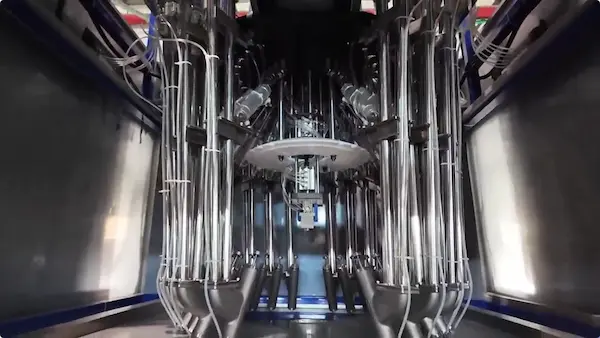
A Triple-Stage Valve, such as those found in the premium SIGHTEC DM-48, introduces a critical intermediate layer.
1.Macro Channel: For bulk filling.
2.Meso Channel: For transitional deceleration.
3.Nano Channel (Ultra-Micro): A dedicated, capillary-like path for the final milligrams.
The Analogy: Fire hose → Garden hose → Pipette. You have a specialized tool for the most critical phase of the dispense.
The Breakthrough: This architecture decouples speed from accuracy. The “Nano Channel” is designed specifically to overcome surface tension, allowing for continuous, controlled micro-dosing without the “hanging drop” phenomenon.
| Performance Metric | Double-Stage Valve | Triple-Stage Valve | Impact on Latex Production |
| Minimum Dispense Quantity (MDQ) | Typically 0.2g – 0.5g | 0.05g – 0.1g | Crucial for light pastel shades. 0.2g of High-Strength Blue is often too much for a pint sample. |
| Terminal Control | Prone to “Pulse Variance” | Linear Approach | 2-Stage valves often overshoot target weight; 3-Stage valves land softly on the target. |
| Viscosity Tolerance | Performance drops at >2000cP | High Stability | 3-Stage valves are less sensitive to temperature-induced viscosity changes in winter/summer. |
How do these engineering differences affect your balance sheet? Let’s audit the hidden costs of using an inferior paint dispenser machine.
The Scenario: You are producing a batch of “Mist Gray” latex paint. The formula requires exactly 4.5g of Carbon Black colorant.
Double-Stage Failure: The valve dispenses 4.2g rapidly. It needs 0.3g more. However, its minimum reliable drop size is 0.35g. It attempts to dispense the final amount and accidentally drops 0.35g.
Result: 4.55g dispensed. The paint is now too dark.
Triple-Stage Success: The Nano channel engages. It dispenses 0.1g, then 0.1g, then 0.1g.
Result: Exactly 4.5g dispensed.
The Financial Impact:
Imagine this 0.05g overshoot happens 50 times a day across various high-strength colorants (costing $30/kg).
Daily Waste: 2.5g
Annual Waste (250 days): Not much, right?
BUT wait. The real cost isn’t the colorant. The real cost is that the batch is now off-spec. You cannot just scoop the colorant out. You must “add back” base paint to dilute the color, or scrap the batch entirely.
The most expensive thing in a factory is a “Hidden Factory“—the unseen resources spent fixing mistakes.
The Risk: With Double-Stage valves, the Process Capability Index (Cpk) is lower. You might have a failure rate of 0.5% due to color mismatch (Delta E > 0.8).
The Consequence:
1.Lab Labor: Technicians must re-sample and calculate a correction formula.
2.Line Stoppage: The mixing tank is occupied while waiting for the lab.
3.Material Loss: Adding base paint to correct the color often leads to “over-batching,” creating more paint than the order required (inventory waste).
The Calculation:
If a Triple-Stage automatic colorant dispenser reduces your rework rate from 0.5% to 0.1% on a volume of 5 million liters/year, you are saving tens of thousands of dollars in operational efficiency—far exceeding the initial cost of the valve upgrade.
The Myth: “Double-Stage valves are faster because they have fewer steps.”
The Reality: Triple-Stage valves are effectively faster for high-precision work.
Why: To prevent overshooting, a Double-Stage system must switch to its slow flow very early in the cycle (e.g., at 80% completion). It spends a long time “creeping” toward the target.
The Advantage: A Triple-Stage system can stay in “Fast” or “Medium” mode until 98% completion because it trusts its Nano channel to stop instantly. This aggressive profile reduces the total dispense time by 10-15 seconds per can.
Scale: For a high-volume paint tinting machine processing 300 cans/day, that’s 1.25 hours of production time gained daily.
Double-Stage Wear: The single “Micro” channel does all the heavy lifting for fine-tuning. It endures high-velocity shear forces, wearing out seals faster.
Triple-Stage Durability: The load is distributed across three channels. Furthermore, premium manufacturers like SIGHTEC use Ceramic-Core 304 Stainless Steel for their Triple-Stage valves, designed to withstand abrasive inorganic pigments (like Titanium Dioxide) for millions of cycles.
We do not argue that every paint dispenser needs Triple-Stage valves. The choice depends on your business model. Use this matrix to decide:
| Your Business Profile | Recommended Technology | The “Why” |
| Commodity Paint: Producing huge batches of low-cost, dark colors (e.g., Roof Coatings, Primers). | Double-Stage | Color tolerance is loose. Speed is prioritized over micro-precision. The ROI for Triple-Stage is longer. |
| Retail & Architectural: Producing light pastels, off-whites, and custom colors for homeowners/contractors. | Triple-Stage (Mandatory) | One drop of black in a gallon of white changes the color visibly. Precision is non-negotiable to avoid customer returns. |
| Lab & R&D: Developing formulas and samples. | Triple-Stage / Lab Doser | R&D requires absolute data integrity. You cannot scale up a formula that wasn’t accurate to begin with. |
| Uncontrolled Environment: Factory has poor temperature control (large viscosity swings). | Triple-Stage | The wider flow bandwidth compensates for viscosity changes in winter/summer, keeping production stable. |
| Smart Factory: Aiming for “Lights Out” manufacturing and Industry 4.0 integration. | Triple-Stage | High process capability (Cpk) is essential for automated systems where no human is checking every can. |
In the context of modern manufacturing, purchasing a Double-Stage valve machine to save money is often a false economy. It is like buying a car with poor fuel efficiency because the sticker price was lower. You pay for the difference at the pump—or in this case, at the dispense nozzle—every single day.
For the modern paint manufacturer aiming to dominate the premium market, the Triple-Stage Valve is not an “optional upgrade”; it is a strategic asset.
It serves as an insurance policy against batch failure.
It acts as a firewall against material waste.
It is the foundation of a reputation for quality.
When you choose a paint tinting machine manufacturer like SIGHTEC, you are not just buying hardware. You are buying a guaranteed output quality. Our Triple-Stage Valve technology is engineered to turn your dispensing process into a profit center, not a cost center.
Do not let invisible inefficiencies drain your margins. It is time to audit your equipment.
[Contact the SIGHTEC Technical Team] today.
Precision pays. Let us prove it to you.