In the world of architectural coatings and latex paint manufacturing, color is not just an aesthetic attribute—it is the product itself. For manufacturers, the ultimate nightmare is the “Scale-Up Gap.” This occurs when a 100ml sample, meticulously approved by a client or R&D, cannot be accurately reproduced in a 1,000-liter production batch.
The financial impact of this gap is staggering. It leads to dead inventory, costly rework with “add-backs,” and delayed shipments.
The solution does not lie in better manual skills; it lies in a synchronized hardware ecosystem. This guide provides a deep dive into the automatic paint dispenser technologies that bridge the divide between the laboratory and the factory floor, ensuring that the transition from gram to ton is seamless, precise, and efficient.
To solve the problem, we must first understand why the paint tinting system often fails during scale-up.
In a traditional setup, the R&D lab and the production floor operate as two separate islands.
1.The Lab: Often uses a manual colorant dispenser or pipettes. Technicians might use a different batch of colorant than the factory, or the manual dosing method introduces human variance.
2.The Factory: Uses a massive automatic paint color dispensing machine. Due to the sheer volume, the minimum dispense quantity (MDQ) of the industrial machine might not be sensitive enough to make micro-corrections, or its calibration curve differs from the lab’s methods.
This disconnection results in a loss of data integrity. The specific gravity, tinting strength, and viscosity behavior of the colorants must be identical in both environments. If you are searching for a paint tinting machine for sale, the first question shouldn’t be about speed—it should be about “scalability.”
The journey to perfect color begins in the lab. For modern latex paint production, the era of manual pipetting is over. To ensure data continuity, laboratories must adopt a specialized automatic color dispenser designed for formulation validation.
A dedicated lab dosing machine is an engineering marvel. Unlike a standard point-of-sale (POS) paint tinting machine found in retail stores, a lab doser is built for gravimetric (weight-based) accuracy.
The Spec: Look for systems capable of ±0.005g precision.
Why It Matters: When creating a 100ml sample of a light pastel shade, the amount of High-Strength Blue might be less than 0.05g. A variance of just 0.01g represents a 20% error, which will shift the Delta E (ΔE) significantly. High-precision colorant dispensers ensure that the recipe locked in the lab is mathematically perfect.
The most critical feature of an advanced lab dispensing system is the ability to share raw material sources with production.
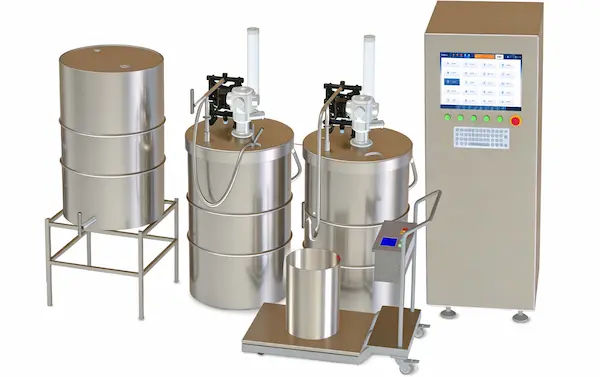
The Setup: Instead of filling internal canisters, the lab machine can draft colorant directly from the same 20L or 200L drums that feed the production line.
The Benefit: This eliminates “Batch-to-Batch” variations in the colorant itself. You are not just simulating production; you are performing a micro-scale production run using identical chemical DNA.
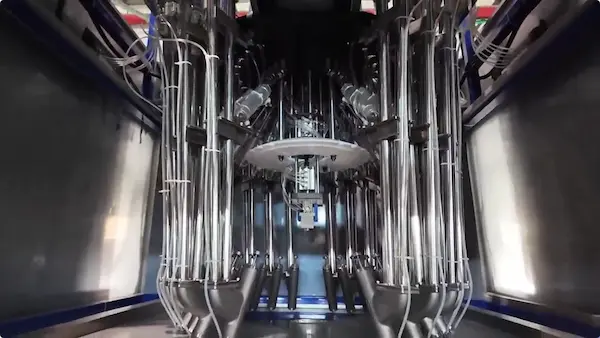
Once the formula is validated, it moves to the factory. Here, the priority shifts from “micro-precision” to “macro-efficiency” without losing accuracy. This is the domain of the industrial automatic paint dispenser, such as the SIGHTEC DM-48 model.

In a factory producing thousands of gallons of latex paint daily, speed is currency.
Simultaneous vs. Sequential: While a manual paint dispenser machine dispenses one color at a time, high-end industrial automatic paint dispensers utilize simultaneous dispensing technology. All required colorants for a recipe are injected at once.
Benchmark: A top-tier system can dispense a complex formula for a 1,000L batch in under 20-25 minutes, whereas sequential systems could take over an hour.
When selecting an automatic paint tinting machine, the choice of pump technology is paramount.
Piston Pumps: Renowned for their extreme accuracy and durability with abrasive colorants (like titanium dioxide whites or iron oxides). They are the gold standard for paint dispenser machines requiring long-term reliability.
Gear Pumps: Often found in ink dispensing systems or lower-viscosity applications. They offer continuous flow but can suffer from wear when handling high-solid latex colorants, leading to a drift in accuracy over time.
The Verdict: For heavy-duty latex paint production, stainless steel piston pump systems (often with ceramic coating) provide the best lifespan and consistent dispenser accuracy test results.
How do you dispense 50kg of colorant quickly but stop at exactly 50.000kg? The answer lies in multi-stage valve architecture.
Coarse Flow: The valve opens fully to deliver 95% of the material at maximum speed.
Fine Flow: As the target weight approaches, the valve restricts to a “dribble” mode.
Pulse Mode: For the final grams, the system uses rapid micro-pulses. This technology allows an oem automatic colorant dispenser to handle 1,000L batches with a deviation of less than ±1g.
A paint dispenser is only as good as its nozzle. The most common search query from maintenance teams is “how to prevent nozzle clogging.” In latex paint production, where colorants are water-borne and fast-drying, nozzle health is critical.
Dried colorant at the nozzle tip is the silent killer of accuracy. A “skin” forming on the tip can deflect the stream or fall into the paint can as a solid chunk.
The Solution: Modern automatic color dispensers feature active humidification caps. When the machine is idle, a sealed cap covers the nozzle array, maintaining a humidity level above 90% to prevent drying.
Reliance on human memory for cleaning is risky. Advanced paint tinting equipment includes programmable “Purge and Wipe” cycles.
Daily Purge: The machine dispenses a small amount of colorant into a waste cup to clear any semi-dried material from the valve.
Automated Brushing: A mechanical brush cleans the nozzle tips after every dispense cycle, ensuring the next batch is not contaminated by the previous color (cross-contamination).
Hardware moves the fluid, but software ensures the color match. The integration between the lab dosing machine and the automatic paint dispenser is managed by the Color Management Software (CMS).
Colorants change density with temperature. A liter of Red Oxide weighs differently in winter than in summer.
Dynamic Adjustment: High-end software monitors the ambient temperature and adjusts the piston stroke or pump rotation to compensate for density changes. This ensures that “1kg” requested by the formula is always “1kg” delivered, regardless of the weather.
Performing a dispenser accuracy test should be part of the weekly routine, but the software makes it easier.
Electronic Calibration: Instead of manually adjusting screws, the operator weighs a dispensed amount, inputs the value into the software, and the system automatically updates its calibration curve.
In a “Smart Factory,” the paint mixing system does not operate in a vacuum.
Workflow:
1.ERP: Receives a customer order (e.g., “500L of RAL 7035”).
2.Server: Checks if the formula has been validated by the Lab Doser.
3.Dispenser: The DM-48 pulls the formula automatically. No manual typing.
4.Traceability: After dispensing, the machine sends the actual consumed weight back to the ERP for inventory deduction and cost analysis.
Upgrading to a fully integrated automatic paint dispensing system is a significant capital expenditure. However, the ROI is measurable and rapid.
A single “mistint” (wrongly colored batch) in a 2,000L tank is a disaster. It wastes base paint, consumes expensive colorant, and occupies the production vessel for days while technicians try to “fix” the color.
Impact: By using a Lab Doser to validate the exact raw materials, the “First Time Right” rate typically exceeds 98%.
With a connected system, a new color developed in the morning can be in production by the afternoon. There is no need for intermediate pilot batches or manual translation of formulas.
A high-capacity automatic colorant dispenser allows one operator to manage multiple tanks. While the machine is automatically dispensing Batch A, the operator can prepare the vessel for Batch B. This transforms the operator from a “laborer” into a “process manager.”
The days of relying on the “Golden Eye” of a master tinter are fading. The future of latex paint production belongs to data-driven precision.
By implementing a strategy that pairs a high-precision Lab Dosing Machine with a robust Industrial Automatic Paint Dispenser, manufacturers can break the chains of the “Scale-Up Effect.” This synergy guarantees that the creativity of the lab is faithfully reproduced on the factory floor, bucket after bucket, ton after ton.
Whether you are looking for a paint tinting machine manufacturer to replace aging equipment or designing a new automatic paint dispensing station from scratch, remember: Consistency is your product. Invest in the technology that protects it.
Ready to revolutionize your color production? SIGHTEC offers the industry’s most advanced solution for “Lab-to-Line” integration. From the 0.005g precision of our Lab Doser to the industrial might of the DM-48, we provide the tools you need to master color.
[Contact SIGHTEC Today] for a consultation on optimizing your paint tinting system and to request a demo of our seamless ERP integration.