The chemical industry in Asia is booming. From Vietnam to China, and India to Indonesia, the demand is skyrocketing.
But here is the hard truth.
If your production line is slow, you are losing money. If your bottles are leaking, you are losing trust.
You might be asking, “How do I keep up?”
The answer isn’t just hiring more people. The answer is smarter technology. Specifically, upgrading your chemical filling equipment.
In this guide, we will break down exactly how to boost your output. We will look at why automation matters and how to pick the right chemical filling machine manufacturer.
Let’s dive in.
Let’s be honest. Manual labor has its limits.
In the past, manual filling was fine. But today? It is a bottleneck.
If you are still relying on hand-filling or outdated semi-automatic tools, you are facing three big problems:
1.Inconsistency: Humans get tired. One bottle has 500ml, the next has 505ml. Over a year, that waste adds up to thousands of dollars.
2.Safety Risks: We are dealing with chemicals here. Spills aren’t just messy; they are dangerous. A modern chemical filling machine minimizes human contact.
3.Speed Caps: A human can only move so fast. An automatic chemical filling machine doesn’t take coffee breaks.
“Give-away” is the product you overfill to ensure you don’t sell under-filled bottles. If you are overfilling by even 1%, you are giving away free product. Precision equipment stops this.
Not all machines are the same.
When you start looking for chemical filling equipment, you will see a lot of options. You need to match the machine to your viscosity and container type.
Here are the main contenders:
Best for: Thin, free-flowing liquids (like water-based solvents or cleaners).
How it works: Gravity does the work. It is simple and cost-effective.
Productivity Level: Medium to High.
Best for: Thick liquids. If you are looking for a paint filling machine or something for heavy pastes, this is it.
How it works: A piston pushes the product into the container. It is very accurate.
Productivity Level: High.
Best for: Clear containers where a consistent visual fill level is important (like cosmetic chemicals).
Productivity Level: Medium.
Best for: Maximum flexibility. You can change fill volumes digitally without mechanical adjustments.
Productivity Level: Very High.
Quick Tip: If you handle a wide variety of chemicals, a servo-driven liquid filling machine is usually the best investment for long-term productivity.
Let’s talk numbers.
Moving from a semi-auto process to a fully automatic chemical filling machine can triple your output overnight.
Here is how automation changes the game:
A standalone machine is good. A fully integrated line is better. Imagine a conveyor system. It feeds the bottles, fills them, caps them, and labels them. No hands touch the bottle until it is packed.
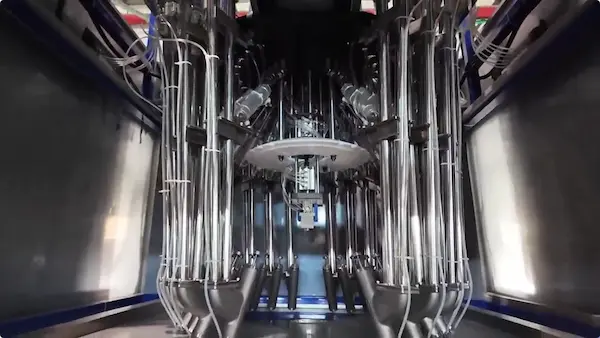
Why fill one bottle when you can fill twelve? Modern chemical industry filling machine setups often come with 4, 8, 12, or even 16 nozzles. This multiplies your output instantly.
This is a huge time saver. Old machines drip. That means you have to stop and clean the conveyor belt. Top-tier chemical filling equipment uses diving nozzles and suck-back systems. The nozzle goes into the bottle, fills it, and retracts without dropping a single drop.
Result: Zero downtime for cleaning spills.
Paint is tricky.
It is thick. It is messy. It dries fast.
If you are in the coatings industry, a standard water filler will fail. You need a specialized paint filling machine.
Viscosity Changes: Paint changes thickness depending on the temperature. A good machine adjusts for this.
Explosion Proofing: Many solvent-based paints are flammable. Your machine must be ATEX or IECEx rated (explosion-proof).
Cleaning: You cannot mix colors. A white paint batch cannot have a drop of red in it.
The Productivity Hack: Look for machines with “Quick Strip” capability. This allows your operators to take apart the contact parts for cleaning without tools. What used to take 2 hours now takes 20 minutes.
This is where many buyers in Asia make a mistake.
They buy the cheapest machine they find on Alibaba. Three months later, it breaks. The seller is gone. Production stops.
Don’t let that be you.
Here is a checklist for finding a trusted chemical filling machine manufacturer or supplier:
Filling water is easy. Filling bleach, acid, or acetone is hard. The manufacturer must know about corrosion resistance.
Ask them: “Do you use 316L Stainless Steel or PVC for corrosive acids?”
If they don’t know the answer, run away.
If your factory is in Thailand and the supplier is in Europe with no local team, you are in trouble. You need a chemical filling machine supplier who can send a technician to your plant within 48 hours.
Is the interface in English? Or your local language? Can you save “recipes”?
Example: You should be able to press a button labeled “500ml Detergent” and the machine auto-calibrates.
Your factory floor has a unique layout. A good manufacturer will customize the conveyor shape (L-shape, U-shape) to fit your space.
Operating a chemical industry filling machine in Asia presents unique challenges compared to Europe or North America.
Asia is humid. High humidity kills standard electronics. Ensure your machine’s electrical cabinet is sealed and air-conditioned if possible. This prevents shorts and rust in the PLC (Programmable Logic Controller).
Voltage instability is common in some industrial zones. Your chemical filling equipment should have servo motors that can handle slight voltage drops without losing accuracy.
The machine needs to be easy to use. Complex menus are bad for productivity. Look for a touchscreen (HMI) that uses pictures and icons, not just text. This makes training new staff much faster.
Buying the machine is just step one. Keeping it running is step two.
The biggest killer of productivity is unscheduled downtime. This happens when a seal breaks or a pump fails in the middle of a shift.
Here is a maintenance schedule to keep your liquid filling machine running like new:
Wipe down the nozzles.
Check for any unusual noise in the conveyor motor.
Ensure the air pressure is stable.
Inspect the O-rings and seals. Chemicals eat rubber. Replace them before they leak.
Lubricate moving parts (but keep grease away from the product!).
Calibrate the fill volume.
Check the software for updates.
Pro Tip: Keep a “Spare Parts Kit” on site. Ask your supplier for a list of “wear parts.” If a $5 seal breaks, you don’t want to wait two weeks for shipping.
Technology moves fast. If you are buying a machine today, look for these smart features:
Instead of measuring volume (which changes with temperature), these machines weigh the bottle as it fills.
Benefit: Perfect accuracy, regardless of heat or bubbles.
Clean-in-Place (CIP) technology is a game changer. You connect a water/solvent source, and the machine cleans itself.
Benefit: Reduces changeover time from 1 hour to 15 minutes.
Some modern automatic chemical filling machines can connect to Wi-Fi. The manufacturer can log in remotely to fix software bugs without visiting your factory.
You might be worried about the cost.
“It is too expensive.”
Let’s look at the Return on Investment (ROI).
Scenario:
Current State: 5 workers manual filling. 1000 bottles per hour. 2% spillage waste.
Future State: 1 automatic chemical filling machine. 1 operator. 3000 bottles per hour. 0.1% spillage waste.
The Savings:
1.Labor: You save the salary of 4 workers.
2.Product: You save 1.9% of your raw material. In the chemical industry, raw materials are expensive.
3.Capacity: You can accept 3x larger orders.
Most factories in Asia see a full ROI in 6 to 12 months. After that, it is pure profit.
Before you sign the check, watch out for these traps.
Buying for today, not tomorrow: Don’t buy a machine that just meets your current demand. Buy one that can grow. Can you add more nozzles later?
Ignoring the cap and label: A fast filler is useless if your capping machine is slow. Balance the line.
Forgetting safety: Ensure the machine has emergency stop buttons and safety guarding. Chemicals are hazardous; safety violations will shut you down.
Improving productivity isn’t magic. It is engineering.
By upgrading to a high-quality chemical filling machine, you are not just buying metal and wires. You are buying speed, accuracy, and peace of mind.
Whether you need a heavy-duty paint filling machine or a precise liquid filling machine for solvents, the right equipment transforms your business.
The Asian market is competitive. To win, you need to be fast and efficient.
Don’t let outdated manual processes hold you back.
Are you tired of leaks, slow output, and maintenance headaches?
We can help you find the perfect solution for your factory. Whether you need a simple semi-auto unit or a fully automatic chemical filling machine line, we have the expertise to guide you.
[Contact Us Today for a Free Consultation]
Let’s boost your output and your profits together. Click below to get a quote from a top chemical filling machine manufacturer.
[Get My Free Quote Now]