Pigment and filler properties: Pigments and fillers in water-based inks generally have higher densities than water (e.g., carbon black: 1.8-2.1g/cm³; titanium dioxide: 3.9-4.2g/cm³). This density difference causes gravitational sedimentation. If the particle size distribution is uneven (particles >20μm account for over 5%) or surface modification is insufficient, agglomerates easily form, accelerating sedimentation.
Insufficient dispersion stability: Water-based ink dispersion systems rely on additives (dispersants, wetting agents) to maintain zeta potential balance (ideal range: -30~-50mV). Insufficient or mismatched dispersants, or inadequate shearing during production, allow pigment particles to overcome double-layer repulsion and flocculate.
Low system viscosity: If water-based ink viscosity is below 1500CPS (25℃), it lacks sufficient suspending power for pigments. Particle sedimentation speeds up significantly in static conditions (following Stokes’ Law).
Conveyance stage: Pipeline design with dead ends, excessive elbows, or slow conveyance speeds (<0.5m/s) causes poor material flow, leading to pigment accumulation and sedimentation. Rough pipeline materials easily adsorb particles, forming deposits.
Buffering stage: Finished product buffer tanks lack stirring devices or have inadequate mixing. When materials sit for more than 2 hours, pigments settle quickly to the tank bottom, forming hard cakes.
Filling stage: Uneven flow rates from filling heads or excessive material impact disrupt the ink system’s stability. Delayed sealing after filling causes water evaporation, increasing viscosity and accelerating sedimentation.
Cleaning stage: Incomplete filling line cleaning leaves residual sediment that contaminates subsequent batches, creating a “cross-sedimentation” cycle.
Secondary dispersion of finished products: Install an inline high-shear disperser (shear rate ≥15m/s, speed 3000-5000r/min) at the filling line inlet. Before entering the line, ink undergoes secondary dispersion to break up minor agglomerates formed during storage, ensuring uniform pigment distribution.
Viscosity and zeta potential calibration: Add inline viscometers and zeta potential meters to monitor ink status in real time (viscosity controlled at 1500-3000CPS, zeta potential ≥-30mV). If viscosity is too low, automatically add thickeners (e.g., hydroxyethyl cellulose); if potential is insufficient, supplement dispersants to maintain system stability.
Filtration and purification: Install a high-precision filter (50μm filtration accuracy) after secondary dispersion to remove unbroken large particles and sediment cakes. This prevents clogging of filling heads and product contamination. Equip the filter with a differential pressure alarm that triggers when pressure exceeds 0.1MPa, prompting filter element replacement.
Use smooth 316L stainless steel pipelines with an inner wall roughness Ra ≤0.8μm to minimize particle adsorption.
Replace right-angle elbows with 45° or 135° elbows to reduce flow resistance.
Set pipeline slopes at 3‰-5‰ to leverage gravity for auxiliary flow, preventing material accumulation in low-lying areas.
Remove valve dead ends and blind pipe sections; install cleaning ports at key nodes for thorough cleaning.
Adopt screw pumps or gear pumps (instead of centrifugal pumps) for stable conveyance pressure (0.3-0.5MPa), avoiding system disruption from pressure fluctuations.
Control conveyance speed at 0.8-1.2m/s—fast enough for smooth flow but slow enough to avoid excessive foaming.
Install a return branch at the end of the pipeline. Unused materials bypass the buffer tank and flow back to the secondary disperser, forming a “conveyance-dispersion-recirculation” loop. This ensures continuous material movement in pipelines, eliminating static sedimentation risks.
Use cone-bottom buffer tanks (60° cone angle) to facilitate bottom material flow and prevent sediment accumulation.
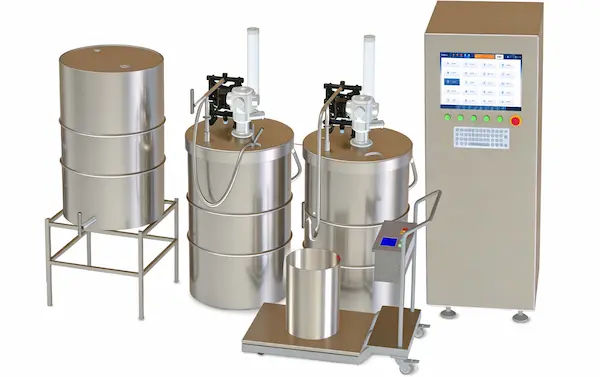
Install dual-layer stirring devices inside the tank: an upper anchor stirrer (speed 30-50r/min) for overall mixing and a lower propeller stirrer (speed 80-100r/min) for enhanced stirring in sediment-prone bottom areas.
Add ultrasonic anti-settling devices (frequency 20-40kHz) to the tank wall. Ultrasonic vibration breaks up particle agglomerates and prevents sediment formation.
Equip the buffer tank with a jacketed constant-temperature device to stabilize material temperature at 25±3℃, avoiding viscosity changes and accelerated sedimentation from temperature fluctuations.
Control liquid levels between 30%-80%. Automatically refill when levels drop below 30% and pause conveyance when levels exceed 80% to prevent overflow or inadequate stirring.
Integrate a CIP (clean-in-place) system into the buffer tank, following a “caustic wash → water rinse → disinfection → air dry” process. Ensure cleaning fluid flow rates ≥1.5m/s for residue-free cleaning. Synchronously clean pipelines and stirrers during batch changes to avoid cross-contamination.
Choose a weighing filling machine (measurement accuracy ±0.2%) that is unaffected by ink viscosity and sedimentation, ensuring consistent batch measurements.
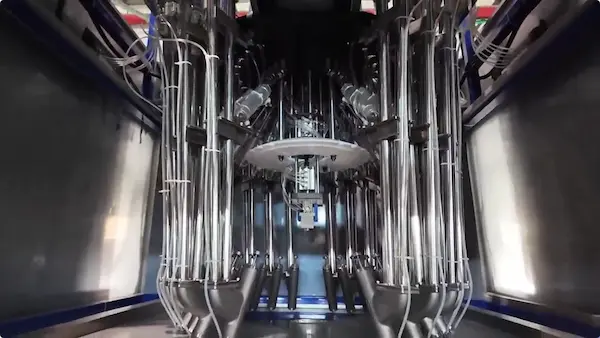
Select filling heads with anti-drip designs (equipped with elastic sealing valves) to avoid sediment caking and drip contamination from residual materials.
Implement phased filling speed control: low speed (5-10L/min) initially to avoid excessive material impact; high speed (15-20L/min) in the middle to boost efficiency; low speed (3-5L/min) at the end for precise topping-up.
Insert filling heads to 2/3 of the container height and use “submerged filling” to minimize air contact, reducing foaming and system disruption.
Ensure synchronous start/stop for multi-head filling machines (2-4 heads) to maintain uniform flow rates and avoid sedimentation differences from uneven material distribution.
Link the filling line with the buffer tank’s stirring system. Automatically increase the buffer tank’s stirring speed by 10%-20% during filling to ensure uniform material conveyance.
Activate the pipeline recirculation system automatically if filling pauses (e.g., container replacement) to prevent material stagnation.
Rapid sealing: Complete capping and tightening within 1 minute of filling to reduce water evaporation and air entry. Install gaskets inside bottle caps to enhance sealing and prevent system imbalance.
Shaking treatment: Equip an automatic shaker. After filling and sealing, shake finished products for 30-60 seconds (speed 60-80r/min) to re-disperse any minor sediment, ensuring uniform consistency before shipment.
Labeling and traceability: Print “Shake before use” prompts on labels. Record filling batch, time, equipment parameters, and other data to enable quality tracing and root-cause analysis for sedimentation issues.
Collect real-time key data across the entire process via sensors:
Material properties: viscosity (1500-3000CPS), zeta potential (-30~-50mV), pigment particle size (≤20μm);
Equipment status: conveyance pump pressure (0.3-0.5MPa), buffer tank stirring speed (30-100r/min), filling speed (3-20L/min);
Environmental parameters: temperature (25±3℃), humidity (40%-60%).
Upload all data to a central control system and display it on a visualization platform. Trigger sound and light alarms for abnormalities.
Implement automatic regulation based on preset parameter thresholds:
Start the thickener addition module automatically if viscosity drops below 1500CPS, with precise dosage control.
Supplement dispersants automatically if zeta potential exceeds -30mV to maintain system stability;
Adjust the buffer tank’s stirring frequency automatically if speed is abnormal, or alert maintenance staff for inspection.
Pause filling if measurement errors exceed ±0.5% and investigate potential density changes caused by sedimentation.
Store parameters for 1000+ water-based ink formulas in the system. Automatically match optimal conveyance speeds, stirring rates, and filling parameters for different pigment types and viscosity ranges, reducing manual intervention.
Record production data for each batch to form a complete traceability chain, facilitating analysis of sedimentation root causes.
Core measures: Pipeline modifications (smooth 316L stainless steel, optimized elbows), high-precision filter installation, simple buffer tank stirring upgrades, anti-drip filling head modifications.
Expected results: Sedimentation rate reduced from 8%-15% to 5%-8%; product qualification rate increased by 10%-15%. Suitable for small ink enterprises.
Core measures: Add inline high-shear dispersers, ultrasonic anti-settling devices for buffer tanks, CIP cleaning systems, and weighing filling machines to the low-cost plan.
Expected results: Sedimentation rate reduced to 3%-5%; production capacity increased by 20%; labor costs reduced by 30%. Suitable for medium-sized ink enterprises.
Core measures: Integrate full-process smart control systems, complete dynamic buffer tank transformations, multi-head linked filling machines, and automatic shaking/traceability systems.
Expected results: Sedimentation rate ≤3%; batch stability ΔE ≤0.4%; production capacity increased by over 30%. Suitable for large ink enterprises or high-end water-based ink production lines.
Pretreatment: Installed inline high-shear dispersers and 50μm filters.
Conveyance: Modified pipelines (316L stainless steel, 45° elbows) and replaced with screw pumps.
Buffering: Transformed to cone-bottom buffer tanks with dual-layer stirring and ultrasonic anti-settling devices; integrated CIP cleaning.
Filling: Replaced with 4-head weighing filling machines and adopted submerged filling.
Smart control: Added viscosity and zeta potential sensors for real-time monitoring and automatic adjustments.
Quality improvement: Sedimentation rate dropped from 12% to 3.5%; product qualification rate rose from 85% to 98.5%; customer complaint rate fell from 7% to 0.9%.
Efficiency improvement: Single-shift production capacity increased from 3,000L to 3,800L; filling errors were controlled within ±0.2%.
Cost reduction: Raw material waste rate decreased from 10% to 4%, saving approximately $4,200 monthly; labor costs reduced by 30%; annual maintenance costs cut by 20%.
Pretreatment: “Break up and purify” to reduce sedimentation risks at the source.
Conveyance and buffering: “Maintain flow and dynamic stirring” to avoid static material.
Filling: “Precision and linkage” to minimize sedimentation’s impact on measurement.
Smart control: “Real-time monitoring and automatic adjustment” to ensure stable optimization results.
In the future, as water-based ink formulas advance and intelligent technologies become more prevalent, filling line optimization will move toward “AI parameter self-optimization and digital twin simulation,” further enhancing anti-sedimentation effectiveness and production efficiency. Enterprises should reserve upgrade space during optimization to lay the foundation for long-term development.