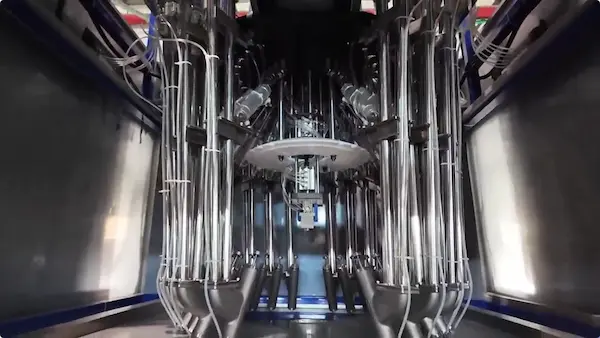
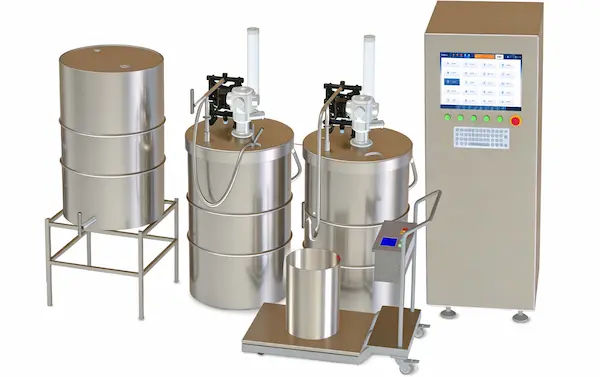
Whether you are running a point-of-sale tinting counter, a mid-size decorative paint production line, or a high-throughput industrial coatings facility, the mixing machine you use determines the consistency, efficiency, and quality of every batch that leaves your floor. This guide explains the core operating principles behind each major type of paint mixing machine, how they differ, and which application each is best suited for.
Paint is not a homogeneous liquid — it is a formulated suspension of pigments, binders, solvents, and additives. Over time, and especially after the addition of colorants during tinting, these components separate. Heavy pigment particles settle toward the bottom; lighter resins float toward the top. A paint batch dispensed or applied without proper mixing will produce uneven color, inconsistent gloss, and poor film performance.
The function of a paint mixing machine is to re-homogenize this suspension into a uniform state — and to do so without introducing air, damaging the pigment dispersion, or altering viscosity in ways that affect application.
Industrial and decorative paint operations use three fundamentally different machine types, each designed for a distinct role in the paint workflow:
Understanding what each machine actually does — mechanically — is the prerequisite for choosing the right one. The wrong equipment type creates quality problems that no amount of calibration can fix.
A disperser — also called a high-speed disperser or dissolving machine — uses a rotating toothed or saw-tooth blade (Cowles blade) mounted on a vertical shaft to create a high-velocity fluid flow inside the mixing vessel. As the blade spins, typically between 1,000 and 3,000 RPM, it generates intense shear forces that physically break apart agglomerated pigment clusters and distribute them evenly throughout the binder system.
The key to effective disperser operation is maintaining what engineers call the donut flow pattern: material drawn down through the blade zone, pushed outward, circulated up the vessel walls, and pulled back into the center. This toroidal circulation ensures every part of the batch passes through the high-shear zone repeatedly.
Dispersers are the workhorse of paint manufacturing. They are used for producing base paints, incorporating titanium dioxide and other dry pigments into resin systems, and manufacturing high-viscosity products like textured wall coatings and elastomeric paints. Sightec’s BS-50 and BS-200 semi-automatic dispersers are engineered for this production environment, with variable-speed control and lift mechanisms for 50L and 200L vessels respectively.
Semi-automatic dispersers like the BS series automate the blade lift and speed ramping sequence, reducing operator fatigue and ensuring consistent dispersion time across batches — a critical factor for color repeatability at scale.
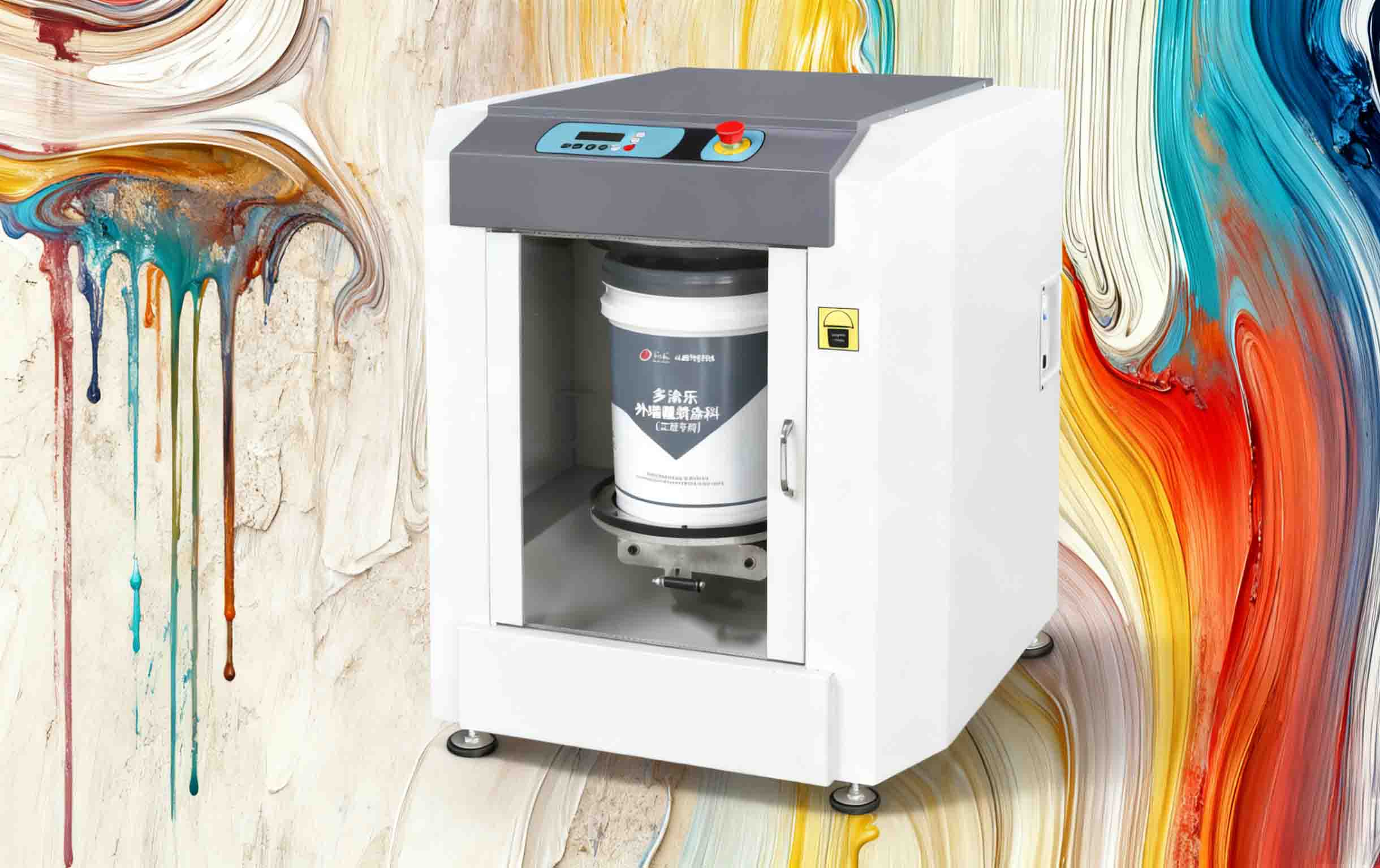
A gyroscopic mixer — sometimes called a gyro mixer or planetary shaker — operates on an entirely different principle. Rather than inserting a blade into the paint, it rotates the entire sealed container simultaneously around two axes: a primary rotation axis and an offset secondary axis. This dual-axis motion creates complex fluid dynamics inside the can that rapidly fold and re-combine the paint layers without any contact between the machine and the product.
Because the container never opens, gyroscopic mixing is particularly well suited to tinted paints immediately after colorant dispensing, and to products containing volatile solvents where opening the lid to insert a blade would cause solvent loss or health and safety concerns.
In decorative and architectural paint tinting operations, the gyroscopic mixer sits at the end of the dispensing line. After colorant is dispensed into the base paint, the can moves directly into the mixer. Sightec’s gyro mixer range — including the CG-2A-03, CG-2A-04, and CG-2A-05 — covers container sizes from 1L to 20L with programmable mixing cycles for different paint viscosities.
A paint shaker uses reciprocating or orbital mechanical motion — driven by an eccentric cam or vibration mechanism — to agitate a clamped paint container. The motion pattern is typically a figure-eight or elliptical path that generates sufficient fluid movement to homogenize settled pigments and freshly added colorants.
Paint shakers are faster to operate than gyroscopic mixers for simple homogenization tasks and are the standard equipment in retail paint counters and hardware store tinting stations. They are, however, less effective than gyroscopic mixers for high-density coatings, metallic paints, and products with significant settling.
Sightec’s shaker range — the CG-2S-02 and CG-2S-03 — is designed for point-of-sale environments where throughput speed and ease of operation are the primary requirements.
| Parameter | Disperser | Gyroscopic Mixer | Paint Shaker |
|---|---|---|---|
| Operating principle | High-shear rotating blade | Dual-axis sealed container rotation | Reciprocating/orbital vibration |
| Container opened? | Yes — blade inserted into batch | No — container stays sealed | No — container stays sealed |
| Typical viscosity range | 500–100,000+ mPa·s | 200–30,000 mPa·s | 200–10,000 mPa·s |
| Primary use case | Paint manufacturing / production | Post-tinting homogenization | Retail tinting / POS |
| Typical mix time | 15–45 minutes (production batch) | 60–120 seconds | 60–180 seconds |
| Container size | 20L–1,000L+ | 0.5L–20L | 0.25L–5L typical |
| Air incorporation risk | Moderate (blade speed dependent) | Low | Low |
The selection decision comes down to where in the paint process the mixing occurs, and the viscosity and volume of the product being mixed.
If you are manufacturing paint from raw materials — incorporating dry pigments, grinding dispersions, or producing high-viscosity textured coatings — a disperser is the right tool. If you are operating a tinting point where pre-made base paints receive colorant additions, a gyroscopic mixer or shaker handles post-tinting homogenization. Many operations require both: a disperser in the production room and gyro mixers or shakers at the customer-facing tinting counter.
Sightec engineers mixing systems for architectural paint, industrial coatings, inks, and specialty chemicals. Browse the full mixing machine range or visit the Paint & Coatings solutions page for application-specific guidance.
What is the difference between a disperser and a gyroscopic mixer?
A disperser uses a high-speed rotating blade to break down pigment agglomerates during paint manufacturing — it is a production machine. A gyroscopic mixer uses dual-axis rotation to re-homogenize a sealed paint can before tinting or use, without opening the container. They serve different stages of the paint process.
How long does it take to mix paint in an industrial mixing machine?
Mixing time depends on the machine type and paint viscosity. A gyroscopic mixer typically homogenizes a standard paint can in 60–120 seconds. A disperser processing a high-viscosity architectural coating batch at production scale may run for 15–30 minutes to achieve full pigment dispersion.
What type of mixing machine is best for thick stone texture coatings?
High-viscosity coatings such as stone texture and elastomeric wall paints require a heavy-duty disperser with sufficient torque to maintain blade speed under load. A standard gyroscopic mixer is not designed for this viscosity range. Sightec’s BS-200 semi-automatic disperser is built for high-viscosity production batches up to 200 litres.
Can a paint shaker replace a gyroscopic mixer?
For standard architectural and decorative paints, a quality paint shaker achieves acceptable homogenization. For high-density or solvent-based coatings, a gyroscopic mixer generally delivers more thorough results in less time. The right choice depends on paint type, container size, and throughput requirements.
Tell us your paint type, viscosity range, and batch volume.
No commitment required — we’ll identify the right configuration for your operation.