In the world of industrial coatings, manufacturers face a constant challenge: efficiently producing both water-based and oil-based paints on the same line. As demand for eco-friendly options grows, the ability to switch between these two chemistries is no longer a luxury—it’s a necessity. However, this introduces a critical production dilemma: how can you achieve rapid changeover while ensuring zero cross-contamination?
The chemistries of water-based ink and oil-based paint are fundamentally incompatible. Think of them as oil and water; they simply don’t mix. Even a tiny residue of oil paint in a water-based system can cause coagulation, gelling, and a dramatic loss of gloss. Conversely, water-based components in an oil-based paint can lead to gelation and flocculation, ruining entire batches and causing costly application defects for your customers.
Solving this challenge isn’t about a simple rinse. It requires a holistic strategy that combines modern equipment, rigorous processes, and smart management. This guide outlines a strategic approach, showing you how to build a flexible and high-quality manufacturing operation.
Before diving into the “how,” we must first agree on the “why.” The core principle is this: Speed is meaningless without purity. Preventing contamination must be a proactive, system-wide goal, not a reactive cleanup effort.
The cost of cross-contamination is immense. It leads to:
Massive Product Loss: Entire batches may need to be scrapped.
Expensive Customer Claims: Defective products can disrupt your clients’ operations, damaging your reputation.
Increased Environmental & Safety Risks: Improper handling of cleaning wastes can create hazards.
Your entire operation must be designed to be “mistake-proof,” embedding the “zero-contamination” mindset into every procedure and piece of equipment.
Your equipment forms the physical backbone of your changeover strategy. Investing in the right paint dispenser machine and line design pays for itself through reduced downtime and guaranteed quality.
1. Dedicated Production Lines (The Gold Standard)
The Approach: Install two completely separate, physically isolated production lines. One is exclusively for water-based ink, the other for oil based paint.
The Advantage: This method entirely eliminates any risk of cross-contamination. Changeover time is effectively zero.
The Consideration: This requires the highest investment in space, equipment, and capital.
2. Modular Design & Quick-Change Systems (The Practical Powerhouse)
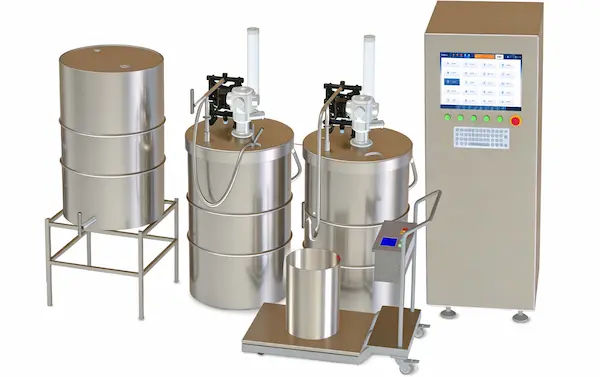
For most manufacturers, a modular approach offers the best balance of flexibility and cost. A modern automatic paint dispenser machine is central to this strategy.
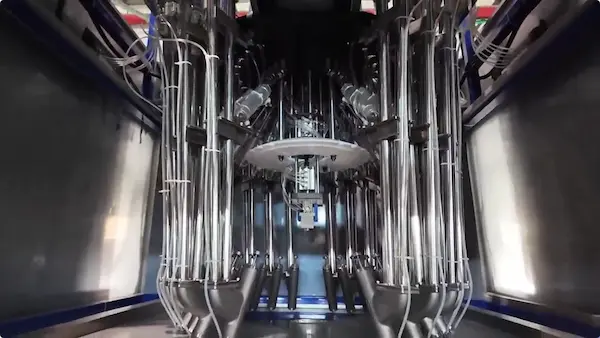
Dedicated, High-Capacity Components: A advanced paint dispenser machine can be configured with multiple dedicated valves. You can assign specific valves for water-based products and others for oil base paint. During changeover, the system automatically selects the correct, clean valve, providing physical isolation at the point of dispensing.
Versatile Container Handling: Look for systems that handle pails, drums, and IBCs. This allows you to process everything from small custom orders to large bulk batches without transferring materials, which itself is a contamination risk.
Performance and Precision: Look for accuracy specs like 0.1g. This high precision is crucial for adding sensitive additives to water-based systems without triggering stability issues. Understanding the factors affecting the automatic paint dispenser machine price is important, as this precision is a key value driver.
The Game-Changer: Automatic Valve Cleaning: This feature is critical for fast, clean changeovers. An integrated cleaner provides a standardized, repeatable wash for the valves, removing residue far more effectively and quickly than manual cleaning. This ensures consistency every single time.
3. Visual Management & ERP Integration
Color-Coding: Use a strict color scheme across your line. Mark all water-based paint dispenser machine components, hoses, and tools in Blue. Mark all oil paint system parts in Red. This visual system prevents human error.
Intelligent Software: A system that links with your factory ERP is a huge advantage. It allows you to track every production order, valve used, and cleaning cycle, creating a full data trail for unparalleled quality traceability.
With a capable platform like an advanced paint dispenser machine, your cleaning process becomes reliable and efficient. We call this the “Three-Stage Cleaning Method.”
Stage 1: Drain and Isolate – Minimize Waste, Maximize Focus
System Drainage: Use the machine’s pump to push residual product back to the supply tank or a dedicated recovery container.
Valve Selection: In the software, pre-select the valve group designated for the next product (e.g., water based ink), avoiding valves just used for oil based paint.
Stage 2: The Three-Stage Clean – A Layered, Scientific Approach
This process is essential when switching from oil paint to water-based ink.
Phase 1: Solvent Flush (Dissolving Oil Residue)
Action: Pump a compatible solvent through the shared lines and valves that need cleaning. A multi-stage valve can optimize this by using different flow rates for a more effective wash.
Emission Control: This closed-loop process contains VOCs, which should be routed to an abatement system.
Phase 2: Alkaline Detergent Wash (Saponification and Deep Clean)
Action: Circulate a heated, specialized alkaline cleaner. The heat improves cleaning power, and the detergent breaks down resinous residues through saponification.
Phase 3: Deionized Water Rinse (The Final Purification)
Action: Flush the entire system with copious amounts of deionized water. This is the most critical step. Never use tap water. The minerals in tap water can destroy the stability of water-based ink.
Success Metrics: Rinse until the outflow water is neutral (pH 7) and its conductivity matches that of fresh deionized water.
Automated Valve Cleaning: Engage the automatic paint dispenser machine’s valve cleaner to perform a targeted, automated purge of the dispensing valves.
Switching from Water-Based Back to Oil-Based: This process is simpler. A thorough deionized water rinse followed by a solvent “purging” and air drying cycle is usually sufficient, as water is less detrimental to oil base paint than solvents are to water-based ink.
Stage 3: Verification – Trust, but Verify with Data
Visual Inspection: Wipe critical internal surfaces with a clean, white lint-free cloth. There should be no color transfer or particles.
First-Article Testing: Before full production, use the cleaned system to make a small sample batch. Send it to the lab for stability, gloss, and color tests. This is your final, and most important, quality gate.
The best hardware and processes need strong management to be effective.
1. Smart Production Scheduling: Batch for Efficiency
Use the high capacity and speed of your paint dispenser machine to implement block production. Schedule “water-based ink production weeks” and “oil paint production runs” to maximize output and minimize the number of changeovers.
2. Adopt SMED Principles: Slash Changeover Time
The Single-Minute Exchange of Die (SMED) philosophy is key.
External Tasks: Prepare all cleaning agents, tools, and spare modules while the line is still running.
Internal Tasks: Streamline every step of the physical dismantling, cleaning, and reassembly.
The modularity and automatic cleaning of a modern paint dispenser machine are perfect for applying SMED.
3. 5S/6S Workplace Organization: A Tidy Battlefield
A clean and organized workshop is fundamental. Implement Sort, Set, Shine, Standardize, Sustain, and Safety around your core equipment.
4. Deep Training and Remote Support
Empower Your Team: Ensure every operator understands the science behind contamination and the operation of the equipment.
Leverage Remote Tech Support: A machine equipped with remote technical support is a powerful asset. Experts can guide your team through complex issues remotely, minimizing costly downtime and accelerating skill development.
5. A Robust Quality Traceability System
Integration with your ERP system creates a digital thread from order to product, linking it to equipment status and cleaning records. This creates a closed-loop management system for continuous improvement.
Mastering the fast and clean changeover between water-based ink and oil-based paint is a complex but achievable goal. It is not about a single solution but the deep integration of advanced hardware, optimized processes, and disciplined management.
Choosing a high-performance, automated, and intelligent automatic paint dispenser machine provides the foundational weapon for this “war between water and oil.” Its modular valve design, automatic cleaning, precision, and software intelligence offer a powerful hardware-based solution to contamination and slow changeovers.
When considering the automatic paint dispenser machine price, view it as an investment in this manufacturing flexibility and quality assurance. Your task is to build the rigorous processes and management system around this technological core.
Mastering this capability does more than solve a technical problem. It gives your business the agility to respond to market changes, the foundation for delivering superior products, and ultimately, a core manufacturing advantage that is very difficult for competitors to replicate.